How Much Should I Invest in Bitcoin as a Beginner? Safe Starting Amounts for 2026
How Much Should I Invest in Bitcoin as a Beginner means deciding how much of your money to put into this digital currency for the first time. Most experts suggest starting with a small amount you can afford to lose completely. It is a personal decision based on your income, savings, and financial goals.
What if a small investment today could change your financial future forever? Many beginners make the mistake of investing too much or too little right from the start. Getting this number right from day one can protect your money and grow your confidence.
Bitcoin is highly volatile, so beginners should never invest more than 5% to 10% of their total savings. Starting small lets you learn how the market works without risking your financial security. The right amount is different for everyone, but being cautious is always the smartest first step.
The Smart Beginner’s Approach to Bitcoin Investment Sizing
Here’s something most financial blogs won’t tell you upfront: the amount you invest in Bitcoin matters far less than how you think about that amount. A person who invests $50 with a clear plan will almost always outperform someone who throws $5,000 in without one. That’s not an opinion that’s the pattern repeated across thousands of beginner investors every single year.
Bitcoin portfolio allocation starts with one golden rule that every serious investor follows: never invest more than you can afford to lose completely. Not partially. Completely. Bitcoin has dropped over 80% in value before, and it could do it again. That’s not pessimism that’s history. So before you type in a dollar amount on any exchange, ask yourself this: if this money disappeared tomorrow, would your life change? If the answer is yes, your number is too high.
Most financial experts recommend keeping your bitcoin exposure between 1% and 10% of your total investment portfolio, especially when you’re just starting with bitcoin. The exact percentage depends on your risk tolerance, your age, and whether you already have an emergency fund in place. Speaking of which — if you don’t have three to six months of living expenses saved in cash, that money comes first. Always. Bitcoin is not an emergency fund. It’s a high-risk asset that deserves only the money you genuinely don’t need for anything else.
Here’s a simple breakdown of what those percentages look like in real dollar terms based on monthly income:
| Monthly Income | 1% Allocation | 5% Allocation | 10% Allocation |
|---|---|---|---|
| $2,000 | $20 | $100 | $200 |
| $3,500 | $35 | $175 | $350 |
| $5,000 | $50 | $250 | $500 |
| $7,500 | $75 | $375 | $750 |
| $10,000 | $100 | $500 | $1,000 |
Look at your income row. That’s your realistic starting range. Not what YouTube influencers say. Not what your coworker claims he made last month. Your number, based on your life.
What Makes Bitcoin Different from Traditional Investments

Most Americans grew up learning about stocks, bonds, and maybe real estate. Bitcoin plays by completely different rules and understanding those differences is the first real step in bitcoin investing basics. When you buy a share of Apple, you own a tiny piece of a real company with employees, revenue, products, and profits. When you buy Bitcoin, you own a piece of a decentralized digital network. There’s no CEO to call. No quarterly earnings report. No dividend check arriving in your mailbox.
Bitcoin volatility is the feature and the flaw that defines it. Traditional stocks might swing 1% to 3% on a dramatic day. Bitcoin regularly moves 5%, 10%, even 20% in a single 24-hour period. In 2021, Bitcoin hit nearly $69,000. By mid-2022, it had crashed below $16,000. That’s a drop of over 76% in less than a year. Anyone who had invested more than they could afford to lose felt that drop in a very real, very painful way.
The IRS treats Bitcoin as property, not currency. That distinction matters enormously for taxes, which we’ll cover later. The SEC has increasingly stepped in to regulate crypto exchanges and products. These regulatory realities make investing in bitcoin for beginners in the USA a more structured process than it was five years ago which is actually good news for you. More oversight means more protection, more legitimate platforms, and clearer rules.
One more thing that separates Bitcoin from everything else: fractional bitcoin ownership. You don’t need to buy a whole Bitcoin — which costs tens of thousands of dollars. You can buy satoshis, the smallest unit of Bitcoin. One Bitcoin equals 100 million satoshis. So investing $50 in bitcoin gets you a real slice of the network, even if it’s a microscopic one. Buying partial bitcoin is completely normal, completely legitimate, and how most beginners start.
Why Investment Amount Matters More Than You Think
Here’s something that sounds simple but most people skip: the amount you invest directly affects your emotional relationship with Bitcoin. Invest too much too soon, and every price dip triggers panic. You start checking your phone at 2am. You sell during crashes. You buy back at highs. This cycle panic sell, regret buy is exactly how beginners lose money in a market that, historically, rewards patience.
Risk tolerance is the financial term for how much pain you can handle without making bad decisions. If investing $500 in bitcoin makes you anxious enough to sell the moment it drops 15%, then $500 is too much for you right now. If investing $100 in bitcoin lets you sleep fine and check your balance once a week, that’s your number. There’s no shame in starting small. There’s only wisdom in knowing yourself.
Managing investment risk begins with matching your investment amount to your emotional threshold. A good test is this: imagine your Bitcoin investment drops 50% next month. How do you feel? If the answer is “devastated,” cut your planned investment in half. If the answer is “mildly annoyed but fine,” you’ve probably found your zone. Starting right here with this honest self-check — separates beginner investors who last from those who quit after their first dip.
Strategic Investment Approaches for Bitcoin Beginners
Once you know your amount, the next question is how to invest it. Dumping everything in at once feels exciting. But it’s often the riskiest move a beginner can make. The two dominant strategies for first bitcoin investment decisions are Dollar-Cost Averaging and lump-sum investing. Understanding both gives you real power over how your bitcoin accumulation strategy unfolds.
Lump-sum investing means buying your entire planned amount in one transaction. It works well when prices are low and you’re confident in a long-term hold. But since beginners rarely have the experience to identify “low” with any accuracy, lump-sum carries more timing risk. If you buy $1,000 of Bitcoin today and the price drops 40% next month, watching $400 evaporate is a brutal lesson.
Dollar-cost averaging bitcoin, on the other hand, spreads your purchases over time. You invest the same fixed amount on a regular schedule — weekly, bi-weekly, or monthly — regardless of price. Some weeks you buy more Bitcoin because prices are low. Some weeks you buy less because prices are high. Over time, these purchases average out to a reasonable entry price. It’s not glamorous. It doesn’t make for exciting dinner party stories. But it works.
Dollar-Cost Averaging: Your Best Friend for Volatility
Think of dollar cost averaging bitcoin the same way you think about buying gas for your car. You don’t wait for the “perfect” gas price. You fill up when the tank is low, whether gas costs $3.10 or $4.50 a gallon. Over a year, your average price per gallon lands somewhere reasonable. Bitcoin DCA works exactly the same way.
Here’s what automated bitcoin investing of just $25 per week looks like over 12 months: that’s $1,300 invested gradually across 52 purchases. During that year, Bitcoin’s price will rise and fall dozens of times. Your $25 purchases during dips buy more Bitcoin. Your $25 purchases during peaks buy less. The result is a smoother, more stable average entry price that protects you from catastrophic bad timing.
The data backs this up powerfully. According to research by River Financial, someone who dollar cost averaged bitcoin with just $10 per week starting in January 2020 through December 2022 a period that included a massive crash still ended up with significant gains by early 2023. Consistent, small, recurring bitcoin purchases beat most timing strategies that beginners attempt.
“The stock market is a device for transferring money from the impatient to the patient.” — Warren Buffett
This quote applies to Bitcoin just as directly. Long-term bitcoin investing through DCA rewards patience in a way that panic-driven lump-sum investments rarely do.
How to Set Up Recurring Purchases
Setting up automated bitcoin investing is easier than most beginners expect. On Coinbase, you click “Buy,” enter your amount, select “Recurring,” and choose your frequency. Kraken offers a similar feature called “Recurring Buy” under your account settings. Cash App lets you set up automatic Bitcoin purchases directly from your linked bank account in under two minutes.
Before you set anything up, pay close attention to fees. Coinbase charges around 1.49% for standard purchases but up to 3.99% for instant card buys. Kraken typically charges 0.26% or less depending on your volume. Over hundreds of recurring bitcoin purchases, that fee difference compounds significantly. A $25 weekly purchase at 1.5% fees costs you about $19.50 per year in fees alone versus $3.38 at 0.26%. Choose your platform with fees in mind.
Pro tip that most guides skip: set your recurring purchase date to coincide with your paycheck deposit. If you get paid every two weeks on Friday, schedule your Bitcoin purchase for that Saturday. The money moves before you have a chance to spend it on something else. Automated bitcoin investing works best when it’s invisible and effortless.
Choosing the Right Frequency and Amount
Weekly bitcoin investment works best for higher earners with consistent cash flow. Monthly bitcoin investment suits those on tighter budgets or irregular income. Bi-weekly matches naturally with most American paycheck schedules. There’s no universally “best” frequency — the best one is the frequency you’ll actually stick to for 12 months or longer without skipping.
Here’s a practical framework based on annual salary:
| Salary Range | Suggested DCA Amount | Suggested Frequency | Annual Bitcoin Investment |
|---|---|---|---|
| Under $30,000 | $10–$25 | Monthly | $120–$300 |
| $30,000–$50,000 | $25–$50 | Bi-weekly | $650–$1,300 |
| $50,000–$80,000 | $50–$150 | Weekly | $2,600–$7,800 |
| $80,000–$120,000 | $150–$300 | Weekly | $7,800–$15,600 |
| $120,000+ | $300–$500 | Weekly | $15,600–$26,000 |
These are starting points, not mandates. Adjust based on your existing debts, savings goals, and risk-based investing comfort level.
The Start Small and Scale Strategy
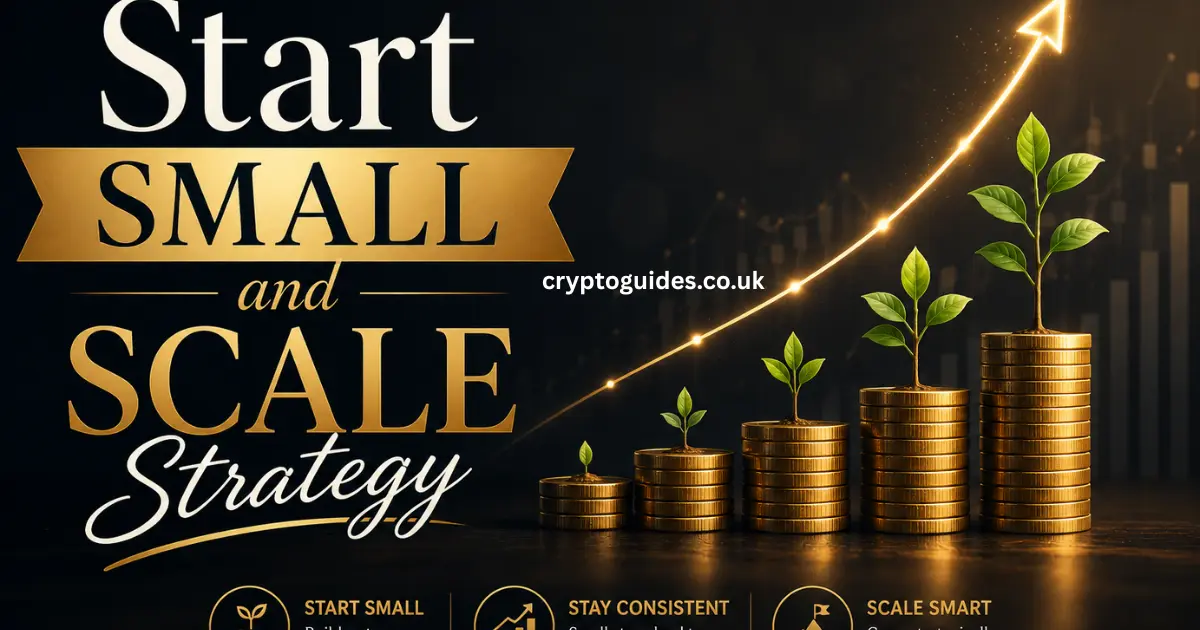
Starting with $100 in bitcoin is not just acceptable it’s genuinely smart for a beginner. Here’s why: your first 90 days of Bitcoin investing are really a learning period, not a wealth-building period. You’re figuring out how exchanges work, how wallets function, how price swings feel in real time. Doing all that learning with $100 at stake is far wiser than doing it with $5,000.
The scale strategy works in milestones. Invest $50 to $100. Stick with it for three months. Learn the platform. Understand your tax obligations. Set up proper security. Then, if you’re comfortable and informed, increase your investment. This approach naturally builds long-term bitcoin allocation habits while protecting you from the expensive mistakes that come with jumping in too deep, too fast.
Investing $1000 in bitcoin makes more sense after you’ve done the groundwork not before. Think of your first small investment as a tuition payment for real-world crypto education. The lessons you learn with $100 are worth far more than the potential gains you’d miss by not starting with $1,000 immediately.
Essential Tools and Setup for Bitcoin Investing
Knowing how to buy bitcoin as a beginner is one thing. Keeping it safe is another challenge entirely. The right setup protects your bitcoin holdings from hacks, scams, and simple human error. This section covers what you actually need before you invest a single dollar.
You need three things at minimum: a reputable exchange account to buy Bitcoin, a bitcoin wallet to store it securely, and a tracking tool to monitor your portfolio. Each piece plays a specific role and skipping any one of them creates unnecessary risk.
Wallet Selection: Hot vs. Cold Storage
A bitcoin wallet doesn’t actually store Bitcoin the way a physical wallet stores cash. It stores the private keys that prove ownership of your Bitcoin on the blockchain. Lose those keys and your Bitcoin is gone forever. No customer service line. No password reset. Gone.
Hot wallets are software-based wallets connected to the internet. They’re convenient, free, and perfect for smaller amounts. Coinbase Wallet, Trust Wallet, and Exodus are popular examples. Cold storage, on the other hand, means storing your private key security information on a device that never connects to the internet. This is the gold standard for secure bitcoin storage.
Here’s a straightforward comparison:
| Feature | Hot Wallet | Cold Wallet |
|---|---|---|
| Cost | Free | $79–$219 |
| Security Level | Medium | Very High |
| Internet Connection | Always connected | Never connected |
| Best For | Small amounts under $500 | Larger long-term holdings |
| Risk Level | Higher (hackable) | Very Low |
| Examples | Coinbase Wallet, Trust Wallet | Ledger Nano X, Trezor Model T |
For a minimum bitcoin investment under $500, a reputable hot wallet is fine while you’re learning. Once your holdings grow, self-custody bitcoin with a hardware wallet becomes strongly advisable.
Hardware Wallet Recommendations
The Ledger Nano X is the most beginner-friendly hardware wallet available in 2026. It costs around $149, connects via Bluetooth, and supports thousands of cryptocurrencies alongside Bitcoin. Setup takes about 20 minutes and the companion app is genuinely easy to navigate.
The Trezor Model T is the open-source alternative, priced around $179. Security researchers widely trust it and its transparent code has been independently verified. Both devices require you to write down a seed phrase backup typically 12 to 24 random words and store it somewhere safe, offline, and physically protected.
One absolute rule: buy hardware wallets only from the official Ledger or Trezor websites. Counterfeit devices sold on Amazon and eBay have been pre-loaded with malware that steals your Bitcoin the moment you set it up. This isn’t a hypothetical risk it has happened to real people. Official site only, every time.
Setting Up Proper Security Measures
Crypto wallet security starts with two-factor authentication, and not the SMS kind. Use an authenticator app like Google Authenticator or Authy. SMS codes can be intercepted through SIM-swapping attacks, which have cost American crypto holders millions of dollars. An authenticator app generates codes locally on your device, making interception virtually impossible.
Your seed phrase backup deserves its own conversation. When you set up any wallet, you’ll receive a series of 12 to 24 words. These words are your master key. Write them on paper not in a notes app, not in an email draft, not in a photo on your phone. Write them on paper and store that paper somewhere physically secure. Some serious holders engrave their seed phrases on fireproof metal plates. That might sound excessive until you hear about people who lost everything in house fires.
Use a dedicated email address for all your digital asset ownership accounts. Don’t use your main Gmail. Create a separate account that you access only for crypto-related logins. Enable 2FA on that email too. These small steps create layers of defense that stop the vast majority of attacks before they start.
Portfolio Tracking and Management Tools

Bitcoin accumulation is more motivating when you can actually see your progress. Portfolio tracking tools turn raw numbers into visual progress you can measure over time.
CoinStats is the best overall choice for beginners. It connects to your exchange accounts automatically, tracks your total portfolio value in real time, and shows your gains and losses clearly. The free tier handles most beginner needs perfectly.
Delta App suits visual learners who want charts and performance breakdowns. It doesn’t connect directly to exchanges, so you log transactions manually which actually builds good record-keeping habits. Kubera stands out for investors who hold Bitcoin alongside traditional stocks, real estate, and other assets, because it tracks everything in one unified dashboard.
How often should you check these tools? Weekly reviews are healthy. Daily checks, especially during volatile periods, tend to trigger emotional decisions. Set a recurring calendar reminder for Sunday evenings to review your bitcoin holdings and leave it alone the rest of the week. Your portfolio grows the same whether you watch it or not.
Tax Implications and Record Keeping
Here’s a fact that surprises almost every beginner: bitcoin taxes are not optional and not complicated once you understand the basics. The IRS has made its position on cryptocurrency crystal clear Bitcoin is property, not currency, and every transaction is a potential taxable event. Ignoring this doesn’t make it go away. It makes it more expensive later.
Bitcoin tax implications apply when you sell Bitcoin for dollars, trade Bitcoin for another cryptocurrency, or use Bitcoin to buy something. Simply buying and holding Bitcoin creates no immediate tax event. But the moment you sell even if you sell at a loss you need to report it.
Understanding Cryptocurrency Tax Requirements
Capital gains tax bitcoin rules work exactly like stock taxes. If you hold your Bitcoin for less than one year before selling, any profit is taxed as ordinary income the same rate as your paycheck. If you hold for more than one year before selling, you qualify for the lower long-term capital gains rate. This distinction alone can save you thousands of dollars on a successful investment.
Here’s what crypto tax reporting looks like in real numbers:
| Holding Period | Tax Rate | Example: $300 Gain | Approximate Tax Owed |
|---|---|---|---|
| Under 12 months | 10%–37% (ordinary income) | $300 | $30–$111 |
| Over 12 months | 0%, 15%, or 20% | $300 | $0–$60 |
| Under 12 months (high earner) | 37% | $1,000 | $370 |
| Over 12 months (most earners) | 15% | $1,000 | $150 |
Taxable crypto transactions get reported on IRS Form 8949 and summarized on Schedule D of your federal return. Most major exchanges like Coinbase generate these forms automatically for US users at year-end. Tools like CoinTracker, Koinly, and TaxBit automate the calculation process for investors who use multiple platforms. For detailed IRS guidance, visit https://www.irs.gov/businesses/small-businesses-self-employed/digital-assets.
Understanding cryptocurrency tax requirements early saves you from ugly surprises come April. Many beginners forget that even investing $50 in bitcoin and selling it six months later for $75 creates a $25 taxable gain. Small amounts feel trivial. They add up.
Essential Records to Maintain
Good crypto tax reporting starts with obsessive record-keeping. Every time you buy Bitcoin, record the date, the amount of Bitcoin purchased, the price per Bitcoin at the time, and the platform you used. Every time you sell, record the same information plus the sale price. This cost-basis information is what determines your actual taxable gain or loss.
Most exchanges provide downloadable transaction histories in CSV format. Download yours at the end of every year and save it somewhere you won’t lose it — a dedicated folder in Google Drive or Dropbox works well. The IRS recommends keeping tax records for at least three years from the date you file, but with crypto’s evolving regulatory landscape, seven years is the safer target.
Cryptocurrency tax rules change regularly as the IRS and Congress continue developing clearer frameworks. Staying current matters. Bookmark the IRS digital assets page and check it at least once a year before tax season.
Common Beginner Mistakes and How to Avoid Them
Every experienced Bitcoin investor has a list of expensive lessons from their early days. The good news is that you don’t have to repeat them. These crypto investing mistakes are predictable, well-documented, and entirely avoidable with the right awareness.
FOMO Investing and Emotional Decision Making
FOMO investing Fear Of Missing Out is the number-one killer of beginner portfolios. It looks like this: Bitcoin has been climbing for weeks. Everyone on social media is celebrating their gains. You feel left behind. So you buy at the peak, right before the correction hits. Then you panic sell near the bottom. Then you watch prices recover and feel sick about it.
This exact cycle played out in late 2021 when Bitcoin approached $69,000. Millions of new investors bought in during that peak, driven by media coverage and social media hype. When the price crashed to under $20,000 in 2022, many of those same investors sold at massive losses. Emotional decision making in markets is expensive, and Bitcoin’s volatility amplifies it dramatically.
The antidote is simple but requires discipline. Write down your investment plan before you buy a single dollar. Decide in advance: “I will invest $X per month for 12 months. I will not sell unless my personal financial situation requires it.” Put that plan somewhere you’ll see it during the next Bitcoin crash. It sounds almost too simple. It works.
“The investor’s chief problem and even his worst enemy is likely to be himself.” Benjamin Graham
Over-Investing Beyond Your Means
Over-investing beyond disposable income investing is a trap that catches beginners who got excited too fast. The warning signs are clear once you know them: you’re skipping bill payments to buy more Bitcoin, you’re losing sleep over price movements, you’re checking prices hourly, or you’re borrowing money to invest. Any one of these is a red flag. All of them together is a crisis.
Investment budgeting starts with your monthly budget, not your excitement about Bitcoin’s potential. Before you commit any amount, map out your essential expenses rent, utilities, groceries, debt payments — and your savings goals. Whatever remains after necessities and savings goals is your disposable income investing pool. Bitcoin gets a slice of that pool, not a replacement for it.
The practical check: could you stop your Bitcoin investments tomorrow and be financially fine? If yes, you’re in a healthy zone. If stopping would cause financial problems because you’ve over-committed you need to reduce your position immediately.
Neglecting Security Best Practices
Crypto investing mistakes around security are uniquely devastating because there’s no recourse. Forget your bank password? Customer service resets it. Lose your Bitcoin private keys? It’s simply gone. Chainalysis estimated that approximately 3.7 million Bitcoin worth over $200 billion at current prices is permanently lost due to forgotten keys, failed drives, and early mining mistakes. That number grows every year.
Phishing attacks targeting beginner investors in the USA increased significantly in 2025 and 2026. Fake exchange websites, fraudulent “support” accounts on X and Telegram, and malicious browser extensions all target people who haven’t yet learned the landscape. The rule is this: no legitimate exchange, wallet service, or support team will ever ask for your seed phrase backup or private key security details. Ever. For any reason. If someone asks, it’s a scam, full stop.
Ignoring Portfolio Diversification
Cryptocurrency portfolio diversification isn’t just financial jargon it’s the practical principle of not putting all your eggs in one basket. Even the most convinced Bitcoin believers keep only a portion of their wealth in crypto. A balanced investment portfolio for a young American investor in 2026 might look like:
| Asset Class | Allocation |
|---|---|
| Index funds / ETFs | 50%–60% |
| Individual stocks | 10%–20% |
| Bonds | 5%–10% |
| Emergency fund (cash) | 10%–15% |
| Bitcoin / Crypto | 5%–10% |
Bitcoin asset allocation above 20% of your total portfolio significantly increases your overall crypto market risk without proportionally increasing your expected return for most investors. Long-term wealth building is built on diversification, not concentration no matter how bullish you feel about any single asset.
Professional Guidance and Disclosure
Everything in this article is educational information, not personalized financial advice. Your personal finance strategy, income, debts, tax situation, and financial goals are unique to you. A certified financial planner specifically one who understands cryptocurrency can review your complete picture and offer guidance that no article can.
To find a fee-only financial advisor who won’t earn commissions from selling you products, visit the NAPFA directory at https://www.napfa.org. Look specifically for advisors with experience in digital assets or cryptocurrency planning. As of 2026, this is a growing specialty within the financial planning profession, and finding one is easier than it was just a few years ago.
Long-term wealth building deserves professional support alongside self-education. Use this guide as a foundation. Build on it with a qualified advisor who knows your numbers.
FAQs
How much should I invest in Bitcoin as a beginner Complete Guide?
Most experts suggest starting with bitcoin at an amount between $50 and $200 enough to be meaningful but small enough that a 50% drop won’t damage your finances. Once you’ve spent 90 days learning the space, you can scale up thoughtfully.
Is $100 enough to invest in bitcoin?
Absolutely. Is $100 enough to invest in bitcoin? Yes and for most beginners, it’s the ideal starting point. You’ll gain real experience with buying, storing, and tracking Bitcoin without exposing yourself to significant risk.
What happens if I invest $100 in Bitcoin today?
If Bitcoin’s price rises 20% over the next year, your $100 becomes $120. If it drops 30%, you have $70. Starting with $100 in bitcoin gives you real skin in the game while keeping potential losses manageable.
Can I buy a fraction of a Bitcoin?
Yes. Can I buy a fraction of a bitcoin? Absolutely. Bitcoin is divisible into satoshis one hundred million satoshis per Bitcoin. You can buy $10, $20, or $50 worth of Bitcoin and own a legitimate fraction of the network.
Should I invest weekly or monthly?
For most beginners, monthly bitcoin investment aligns best with budgeting cycles. If you earn enough to invest smaller amounts weekly without feeling the pinch, weekly bitcoin investment further smooths your average entry price.
Can Bitcoin make you rich?
Can bitcoin make you rich? Early investors who bought and held certainly saw life-changing returns. But past performance guarantees nothing. Bitcoin can also lose significant value. Treat it as one component of a balanced investment portfolio, not a get-rich-quick scheme.
Is it too late to buy Bitcoin?
Is it too late to buy bitcoin? This question gets asked at every price level, and the honest answer is: nobody knows. What’s true is that long-term bitcoin investing through DCA has historically rewarded patient holders more than market timers.
What is the safest way to invest in Bitcoin?
The safest way to invest in bitcoin combines a regulated USA exchange like Coinbase or Kraken, a hardware wallet for storage, strong security practices including 2FA, and a DCA strategy that removes emotional timing decisions from the equation.
Can I lose money investing in Bitcoin?
Can I lose money investing in bitcoin? Yes, entirely possible. Bitcoin has no guaranteed return. You can lose part or all of your investment. That’s why the “invest only what you can afford to lose completely” rule isn’t just advice it’s the foundation of responsible bitcoin for new investors.
Need Help With Your Investments?
If you’re ready to take the next step but want more support, several beginner-friendly resources exist specifically for USA investors navigating the bitcoin investment guide landscape. Coinbase offers a robust educational library at learn.coinbase.com. Kraken’s blog covers bitcoin investing basics in plain English. Reddit communities like r/Bitcoin and r/personalfinance offer real-world perspectives from thousands of investors at every experience level.
The most important step is the first one. How much bitcoin should I buy to start? Enough to matter, small enough to be comfortable. Then learn, grow, and scale with confidence.
Conclusion
How much should you invest in Bitcoin as a beginner? Start with an amount you can afford to lose entirely typically 1% to 10% of your investment portfolio, spread through consistent dollar-cost averaging bitcoin purchases over time. Build your security setup properly. Understand your bitcoin tax implications before you sell anything. Avoid emotional decisions. Diversify.
Beginner bitcoin investment isn’t about finding the perfect moment or the perfect amount. It’s about starting with a clear, honest plan and sticking to it through the inevitable ups and downs that define this market. The beginner who invests $50 per month with discipline and patience will likely outperform the one who invests $5,000 impulsively and panics at the first dip.
Start small. Stay consistent. Keep learning. That’s the whole strategy and it works.
This article is intended for informational and educational purposes only and should not be considered financial, investment, tax, or legal advice. Always conduct your own research and consult a qualified professional before making any financial decisions.

I am an SEO and Guest Posting expert with 5+ years of professional experience in building high-authority backlinks, strategic outreach, and scalable SEO campaigns, especially in the Crypto and Blockchain industry. Passionate about helping brands achieve sustainable organic growth, I specialize in guest posting, white-hat authority link building, content outreach, and digital PR strategies that enhance online credibility and search engine performance. Over the years, I have collaborated with international clients and global brands, delivering result-driven SEO solutions and placements on high-authority, high-DR websites focused on increasing organic traffic, domain authority, and online visibility in competitive markets.