
What Is a Bitcoin Layer 2 Blockchain? How It Works and Why It Matters in 2026
Bitcoin Layer 2 blockchain is a second network built on top of Bitcoin. It helps Bitcoin handle more transactions faster. It works alongside Bitcoin without changing its core rules.
Sending Bitcoin in seconds, not hours. What if fees cost almost nothing? Bitcoin Layer 2 makes this a real possibility today.
Layer 2 protocol solutions like the Lightning Network process payments off the main chain. They bundle transactions and settle them on Bitcoin later. This keeps Bitcoin blockchain secure while making it far more useful.
What Is a Bitcoin Layer 2 Blockchain?
Think of the Bitcoin blockchain as a busy motorway — reliable, secure, and trusted by millions. Now imagine express side roads running alongside it, handling traffic faster and more cheaply, before merging back onto the main road. That’s exactly what a Bitcoin Layer 2 blockchain does. It’s a secondary network or protocol built on top of Bitcoin’s base layer, designed to handle transactions off-chain while still anchoring its security to Bitcoin itself.
At its core, a Bitcoin Layer 2 solution doesn’t change Bitcoin. It doesn’t touch the rules. It doesn’t alter the code. Instead, it runs parallel to the main Bitcoin infrastructure, processing thousands of transactions quickly and cheaply, then settling the final results back on the Bitcoin main chain. This design is intentional and smart. Bitcoin’s base layer prioritises security and decentralisation above all else — and rightly so. But that priority comes at a cost: speed and scalability suffer. Bitcoin Layer 2 networks step in to fill that gap without compromising what makes Bitcoin great in the first place.
The most well-known example is the Lightning Network, a Layer 2 protocol that enables near-instant, low-fee Bitcoin payments between users anywhere in the world. But the Bitcoin Layer 2 blockchain landscape has grown dramatically. Today, projects like Stacks, RSK (Rootstock), Liquid Network, and Merlin Chain are pushing the boundaries of what’s possible on top of Bitcoin — including Bitcoin smart contracts, Bitcoin DeFi, and full Web3 on Bitcoin experiences. In short, a Bitcoin Layer 2 blockchain is the engine room that transforms Bitcoin from a slow-but-secure settlement layer into a fast, programmable, global financial network.
Why Does Bitcoin Need Layer 2 Solutions?
Here’s a number that should stop you in your tracks: Bitcoin processes roughly 7 transactions per second. Visa, by comparison, handles around 24,000 transactions per second. That’s not a small gap — it’s an enormous canyon. And as Bitcoin adoption grows globally, that gap becomes harder to ignore. Bitcoin scalability is, without question, one of the biggest challenges the Bitcoin ecosystem faces today.
The problem isn’t that Bitcoin is poorly built. Quite the opposite. Bitcoin was designed to prioritise security and decentralisation above everything else. Every transaction gets confirmed by thousands of nodes worldwide. Every block takes about 10 minutes to mine. Those features make Bitcoin extraordinarily trustworthy — but they also make it slow. During periods of high demand, fees can spike to £30, £50, or even more per transaction. Try using that to pay for a cup of coffee in London or a parking ticket in New York — it simply doesn’t work.
This is where the famous Blockchain Trilemma comes in. Vitalik Buterin, the co-founder of Ethereum, described it best: a blockchain can only optimise for two of three properties at once — security, decentralisation, and scalability. Bitcoin chose security and decentralisation. That was the right call. But it means Bitcoin transactions on the base layer will always be somewhat slow and costly. Changing Bitcoin’s fundamental rules to fix this would be deeply risky and divisive — just look at the bitter debates that led to Bitcoin Cash’s split in 2017.
Bitcoin scaling solutions exist precisely to solve this without breaking anything. Rather than touching the base layer, Bitcoin Layer 2 solutions handle the heavy lifting elsewhere, then report back. It’s a bit like settling your bar tab at the end of the night rather than paying after every drink — the transactions still happened, they’re still valid, but the settlement comes later in one clean sweep. That approach preserves Bitcoin’s integrity while unlocking speed and affordability for everyday use.
How Does a Bitcoin Layer 2 Blockchain Work?
Understanding how a Bitcoin Layer 2 blockchain works doesn’t require a computer science degree. The concept is actually quite elegant once you see it. At its most basic level, Bitcoin Layer 2 works by moving transactions off the main Bitcoin blockchain, processing them quickly and cheaply in a separate environment, and then settling the final balances back on-chain. Let’s walk through it step by step.
Step 1 — Opening a Channel: Two parties (say, Alice and Bob) both lock up a small amount of Bitcoin in a special address on the main Bitcoin blockchain. This is called opening a payment channel. Think of it like both parties depositing money into a shared escrow account.
Step 2 — Transacting Off-Chain: Once the channel is open, Alice and Bob can send Bitcoin back and forth as many times as they want — instantly and with almost zero fees. These transactions happen entirely off-chain. No miners are involved. No blocks need to be confirmed. It’s just the two parties exchanging cryptographically signed balance updates.
Step 3 — Cryptographic Security: Every balance update is signed by both parties using private keys. This means neither Alice nor Bob can cheat the other. If Alice tries to broadcast an old, outdated balance, the system detects it and penalises her. The cryptographic proofs built into the Layer 2 protocol keep everything honest without needing a third party.
Step 4 — Closing the Channel: When Alice and Bob are done transacting, they close the channel. The final balances get broadcast to the main Bitcoin blockchain and settled on-chain. Only two transactions touch the main chain — the opening and the closing — no matter how many hundreds of transactions happened in between.
This is the genius of the Bitcoin Layer 2 blockchain model. It achieves massive scalability improvements without sacrificing Bitcoin’s core security model. The main chain acts as the ultimate judge and record-keeper — but it only gets involved when necessary. For Bitcoin Layer 2 projects like the Lightning Network, this model enables millions of fast Bitcoin transactions per second, globally, at a fraction of a penny each.
It’s also worth noting that not all Bitcoin Layer 2 networks work exactly the same way. Bitcoin sidechains like RSK and Liquid run as separate blockchains with their own consensus rules, pegged to Bitcoin’s value. Rollups batch many transactions together and compress them before posting proof back to the Bitcoin blockchain. Each approach has its own trade-offs, which we’ll explore shortly.
Key Features of Bitcoin Layer 2 Networks
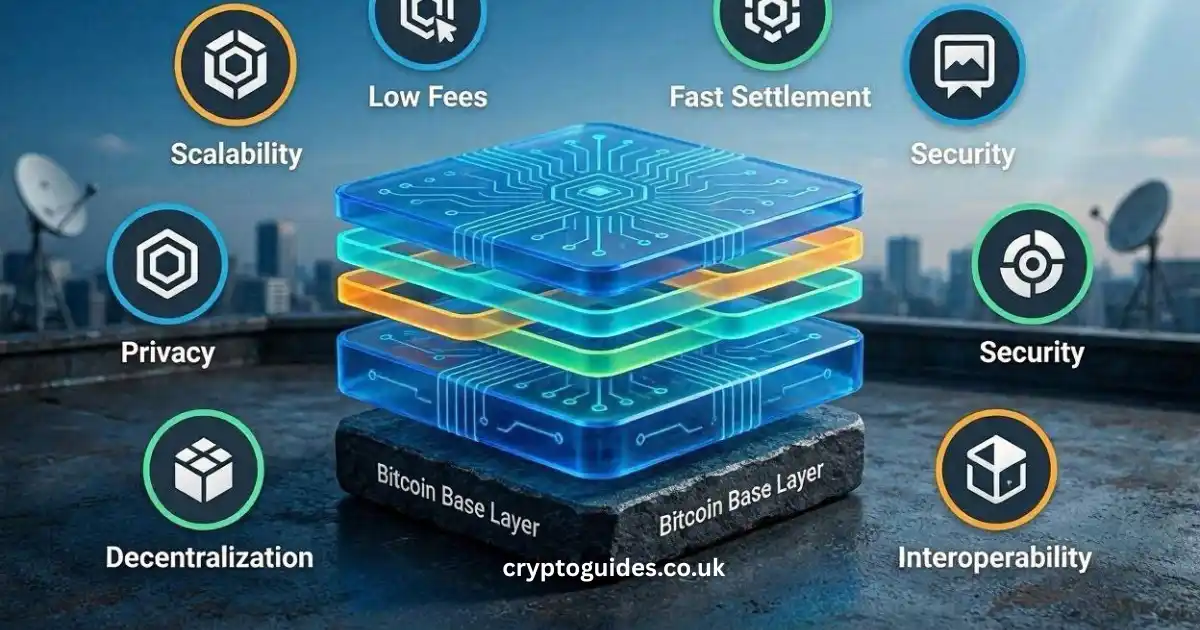
What makes Bitcoin Layer 2 networks so compelling isn’t just the speed. It’s the combination of features that, together, open up an entirely new world of possibilities for the Bitcoin ecosystem. Here’s a clear breakdown of what you get with a well-built Bitcoin Layer 2 blockchain:
| Feature | What It Means for You |
|---|---|
| Speed | Near-instant transactions — seconds, not 10-minute block times |
| Low Fees | Send low-fee Bitcoin payments for fractions of a penny |
| Scalability | Thousands to millions of Bitcoin transactions per second |
| Security | Anchored to Bitcoin’s battle-tested Bitcoin blockchain |
| Smart Contracts | Bitcoin smart contracts on supported Layer 2s |
| Interoperability | Works across wallets, apps, and Bitcoin Layer 2 projects |
| Programmability | Enables Bitcoin DeFi and Web3 on Bitcoin experiences |
| Micro-payments | Pay tiny amounts — impossible on Layer 1 due to fees |
Speed is the headline feature, but security is what makes it credible. Because Bitcoin Layer 2 solutions ultimately settle on the Bitcoin blockchain — the most secure and decentralised network ever built — users don’t have to choose between fast and safe. They get both. And for developers, the ability to build Bitcoin smart contracts and Bitcoin DeFi applications on Layer 2 opens up an entirely new creative and commercial landscape that simply didn’t exist a few years ago.
Types of Bitcoin Layer 2 Solutions
Not all Bitcoin scaling solutions are built alike. The Bitcoin Layer 2 blockchain space includes several distinct types of solutions, each with its own architecture, strengths, and trade-offs. Understanding the differences helps you make smarter decisions about which one fits your needs.
Payment Channels are the simplest and most established type of Bitcoin Layer 2. The Lightning Network is the prime example. Two or more parties lock funds on-chain and then transact freely off-chain. It’s fast, cheap, and battle-tested — ideal for fast Bitcoin transactions and everyday low-fee Bitcoin payments. The limitation? You need to keep channels open and funded, which requires some liquidity management.
Bitcoin sidechains are independent blockchains that run alongside the Bitcoin blockchain and are pegged to Bitcoin’s value. RSK (Rootstock) and the Liquid Network are the most prominent examples. Bitcoin sidechains have their own consensus mechanisms and can support rich Bitcoin smart contracts and even Bitcoin DeFi — but they introduce some trade-offs in decentralisation since they rely on a federation of validators rather than Bitcoin’s full node network.
Rollups are newer to the Bitcoin world but gaining fast momentum. Rollups batch many transactions together off-chain, compress the data, and post a cryptographic proof back to the main Bitcoin blockchain. ZK-rollups (Zero-Knowledge rollups) are particularly exciting because they allow the main chain to verify thousands of transactions with a single compact proof. Projects like Merlin Chain are pioneering this approach in the Bitcoin Layer 2 blockchain space.
State Channels are a broader version of payment channels. While payment channels handle only Bitcoin payments, state channels can handle any kind of state update — think of game moves, votes, or contract updates. They’re more flexible but also more complex to implement correctly within the Bitcoin ecosystem.
Top Bitcoin Layer 2 Blockchains in 2026
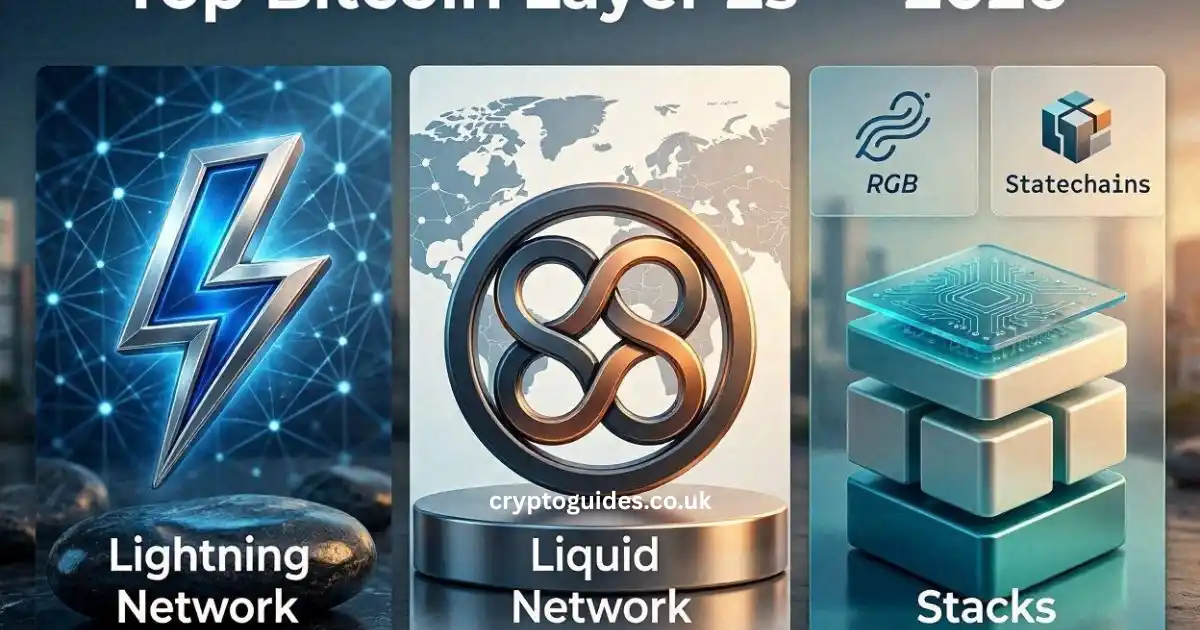
The Bitcoin Layer 2 blockchain space has matured significantly. In 2026, developers and investors have more credible, battle-tested options than ever before. Here’s a look at the leading Bitcoin Layer 2 projects making waves right now:
| Layer 2 Name | Type | Key Strength | Best For |
|---|---|---|---|
| Lightning Network | Payment Channel | Ultra-fast micropayments | Everyday low-fee Bitcoin payments |
| Stacks (STX) | Sidechain | Smart contracts + Bitcoin DeFi | Developers & dApps |
| RSK (Rootstock) | Sidechain | EVM-compatible | Ethereum devs building on BTC |
| Liquid Network | Sidechain | Fast asset transfers | Traders & exchanges |
| BOB (Build on Bitcoin) | Hybrid Layer 2 | EVM + Bitcoin security | Multi-chain builders |
| Merlin Chain | ZK Rollup | Scalability + Bitcoin DeFi | DeFi users & developers |
| Ark Protocol | Layer 2 Protocol | Privacy + scalability | Privacy-focused payments |
The Lightning Network remains the most widely used Bitcoin Layer 2 solution, with over 60,000 active channels and growing merchant adoption across the UK and USA. Stacks has carved out a strong niche as the go-to platform for Bitcoin smart contracts and Web3 on Bitcoin development. Meanwhile, ZK-rollup-based projects like Merlin Chain are attracting developers who want the best of Ethereum’s DeFi ecosystem built on top of Bitcoin’s security model. The race is very much on — and 2026 is shaping up to be the most competitive year yet for Bitcoin Layer 2 networks.
Bitcoin Layer 2 vs Bitcoin Layer 1: What’s the Difference?
Think of Bitcoin Layer 1 as the vault — impenetrable, permanent, and the ultimate source of truth. Bitcoin Layer 2 is your everyday wallet — nimble, fast, and built for spending. Both are essential. Neither replaces the other. Here’s how they compare directly:
| Factor | Bitcoin Layer 1 | Bitcoin Layer 2 Blockchain |
|---|---|---|
| Speed | ~10 minutes per block | Near-instant (milliseconds) |
| Fees | Can be £10–£50+ during peak | Fractions of a penny |
| Security | Maximum — full node consensus | Relies on Layer 1 as final arbiter |
| Use Case | Store of value, large settlements | Daily Bitcoin transactions, micropayments |
| Scalability | ~7 transactions per second | Thousands to millions per second |
| Smart Contracts | Very limited (Script only) | Full Bitcoin smart contracts on some L2s |
| Decentralisation | Maximum | Varies by solution |
| Finality | Irreversible after 6 confirmations | Instant off-chain, final on-chain at close |
The key insight here is that Bitcoin Layer 1 and Bitcoin Layer 2 aren’t competitors — they’re partners. Layer 1 provides the trust. Layer 2 provides the speed. Together, they form a complete Bitcoin infrastructure capable of serving everyone from the individual buying coffee to the institution settling billion-dollar trades.
Bitcoin Layer 2 vs Ethereum Layer 2
This is one of the most talked-about comparisons in crypto circles right now — and for good reason. Both Bitcoin Layer 2 and Ethereum Layer 2 are trying to solve the same fundamental problem: blockchain scalability. But they come from very different starting points and serve somewhat different purposes.
Ethereum got a head start in the Layer 2 race. Projects like Arbitrum, Optimism, and Base have processed billions of dollars in transactions and attracted vast developer ecosystems. Ethereum’s Layer 2 growth was fuelled by the explosion of DeFi and NFTs — activities that demand fast, cheap transactions. The infrastructure is mature, the developer tooling is excellent, and the user base is enormous.
Bitcoin Layer 2 networks, by contrast, are earlier in their development cycle — but catching up fast. The Bitcoin ecosystem brings something Ethereum can’t fully match: the most trusted, decentralised, and secure blockchain ever built. When Bitcoin Layer 2 projects like Stacks and RSK offer Bitcoin DeFi and Bitcoin smart contracts, they’re doing so on top of a security foundation that Ethereum Layer 2s can only envy. That matters enormously to institutions and to long-term holders.
| Factor | Bitcoin Layer 2 | Ethereum Layer 2 |
|---|---|---|
| Base Layer Security | Bitcoin (highest) | Ethereum (high) |
| Ecosystem Maturity | Growing fast | More mature |
| DeFi Activity | Emerging Bitcoin DeFi | Well-established |
| Smart Contract Support | Yes (Stacks, RSK) | Yes (native EVM) |
| Developer Tools | Improving rapidly | Excellent |
| Trust & Brand | Unmatched | Strong |
| Web3 on Bitcoin | Active development | N/A |
The honest truth is that both ecosystems will likely thrive. They serve different audiences and different needs. But as Bitcoin Layer 2 blockchain infrastructure matures through 2026 and beyond, the gap between the two is narrowing rapidly.
Benefits of Using Bitcoin Layer 2 Networks
The benefits of Bitcoin Layer 2 go far beyond just “faster and cheaper.” When you zoom out and look at what Bitcoin Layer 2 networks actually enable, you start to see a transformation in how Bitcoin itself can function in the world.
Speed is the most immediate benefit. Where a standard Bitcoin transaction on Layer 1 takes 10 minutes to an hour to confirm, fast Bitcoin transactions on the Lightning Network or other Bitcoin Layer 2 blockchain solutions confirm in milliseconds. That’s the difference between Bitcoin working as a payment network and Bitcoin being stuck as a settlement layer only.
Cost is the second massive advantage. Low-fee Bitcoin payments on Layer 2 cost a tiny fraction of what Layer 1 fees cost during congested periods. For individuals in the UK sending remittances abroad, or small businesses in the USA accepting Bitcoin payments, this is transformative. It makes Bitcoin viable for transactions of any size — including tiny micropayments worth less than a penny, which are literally impossible on Layer 1.
Programmability is where things get really exciting. Bitcoin smart contracts on Layer 2 platforms like Stacks unlock a world of Bitcoin DeFi — decentralised lending, borrowing, trading, and yield generation — all secured by the Bitcoin blockchain. This is the foundation of Web3 on Bitcoin, and it’s growing fast.
Financial inclusion is perhaps the most profound benefit of all. The Lightning Network has already enabled millions of people in El Salvador, Nigeria, and across Southeast Asia to use Bitcoin for everyday transactions. For someone in a country with an unstable currency and expensive banking infrastructure, low-fee Bitcoin payments over Bitcoin Layer 2 networks can be genuinely life-changing.
Challenges and Limitations of Bitcoin Layer 2
It would be dishonest to talk about Bitcoin Layer 2 blockchain solutions without addressing the real challenges they face. No technology is perfect — and the Bitcoin Layer 2 space is no exception.
Liquidity constraints are one of the biggest practical challenges for payment channel solutions like the Lightning Network. To receive payments, a channel must have sufficient inbound liquidity. Managing this is complex, especially for new users or small merchants. It’s one reason why the user experience still feels clunky compared to a simple bank transfer.
User experience remains a significant barrier to mass adoption. Opening a channel, managing liquidity, choosing routing paths — these concepts are alien to most people. While wallet apps have improved dramatically, they still can’t match the simplicity of tapping your card at a London coffee shop. Until the UX is truly seamless, Bitcoin Layer 2 adoption will remain limited to more technically savvy users.
Decentralisation trade-offs are a concern with some Bitcoin Layer 2 networks, particularly Bitcoin sidechains like Liquid Network, which rely on a federation of trusted validators. This introduces a degree of centralisation that purists — and rightly so — find uncomfortable. It’s a meaningful trade-off that users should understand.
Regulatory uncertainty in both the UK and USA adds another layer of complexity. As governments develop clearer frameworks for crypto assets, Bitcoin Layer 2 projects may face new compliance requirements, particularly those enabling Bitcoin DeFi and Web3 on Bitcoin functionality.
Smart contract risk applies specifically to Bitcoin Layer 2 solutions that support programmable contracts. Bugs in smart contract code can and do get exploited. Even on the most robust Bitcoin infrastructure, the application layer can have vulnerabilities. Audits help, but they’re not foolproof.
Real-World Use Cases of Bitcoin Layer 2

The most powerful argument for Bitcoin Layer 2 blockchain technology isn’t theoretical — it’s the real-world impact already happening across the globe. From micropayments to decentralised finance, the use cases are compelling, practical, and growing.
Everyday Payments are the most obvious and impactful use case. El Salvador made Bitcoin legal tender in 2021, and the Lightning Network powers millions of small daily transactions there — from buying food to paying bus fares. In the UK and USA, a growing number of merchants now accept Lightning Network payments, offering customers fast Bitcoin transactions with low-fee Bitcoin payments that settle instantly. Strike, a payments app built on Lightning, has processed hundreds of millions of dollars in transactions across the USA alone.
Cross-border remittances are a massive opportunity. Every year, millions of people in the UK and USA send money to family abroad. Traditional remittance services charge 5–10% in fees and can take days. Using Bitcoin Layer 2 networks, the same transfer completes in seconds for a fraction of a cent. For a UK-based worker sending £300 home to Nigeria every month, that’s a meaningful saving that adds up to hundreds of pounds per year.
Bitcoin DeFi is rapidly emerging as a major use case. Platforms built on Stacks and RSK now offer decentralised lending, borrowing, and trading — all secured by the Bitcoin blockchain. As of 2026, the total value locked (TVL) in Bitcoin DeFi protocols has crossed $1 billion, signalling serious and growing interest from both retail and institutional participants.
Gaming and NFTs on Bitcoin have exploded thanks to the Ordinals protocol and Bitcoin Layer 2 projects that support digital assets. Gamers can now own in-game items as Bitcoin-native assets, trade them on Bitcoin Layer 2 marketplaces, and interact with game economies in ways that were simply impossible on Layer 1.
Machine-to-machine payments represent a futuristic but very real use case. As the Internet of Things (IoT) expands, devices need to pay each other automatically — a self-driving car paying a toll, a smart meter settling an electricity bill. The Lightning Network’s micropayment capability makes this possible in a way that no bank-based system could match.
How to Choose the Right Bitcoin Layer 2 Blockchain
With so many Bitcoin Layer 2 projects now available, choosing the right one can feel overwhelming. But the decision gets much simpler once you’re clear on what you actually need. Here’s a practical framework to guide your choice.
Define your primary use case first. If you want to send and receive fast Bitcoin transactions for everyday payments, the Lightning Network is your best bet — it’s the most mature, widely supported, and user-friendly option in the Bitcoin Layer 2 blockchain space. If you want to build or use Bitcoin DeFi applications, Stacks or RSK offer far richer smart contract environments. If you’re a developer coming from Ethereum and want EVM compatibility, RSK is the most natural fit.
Consider decentralisation. If Bitcoin’s trustless, decentralised nature is a core priority for you, payment channel solutions like Lightning are more aligned with that ethos than federated Bitcoin sidechains. Know what trade-offs you’re making.
Check wallet and tool support. Not every Bitcoin Layer 2 solution is supported by popular wallets. Before committing, check whether your preferred wallet — whether that’s Muun, Wallet of Satoshi, Xverse, or another — supports the Layer 2 protocol you’re considering.
Assess community and developer activity. A thriving developer community is a strong signal of a healthy Bitcoin Layer 2 blockchain project. Check GitHub commit activity, developer forums, and community size. For the long term, active development matters enormously.
Understand the fee structure. While all Bitcoin Layer 2 networks offer lower fees than Layer 1, they’re not all equal. Some solutions charge routing fees, others have subscription-like models or require on-chain transactions to open/close channels. Know exactly what you’ll pay before you commit.
Is Bitcoin Layer 2 Safe for Users and Developers?
Security is, understandably, the first question anyone asks before putting real money into a new system. The good news is that Bitcoin Layer 2 blockchain solutions are generally very safe — but with important nuances that both users and developers need to understand.
For users, the most important thing to know is that Bitcoin Layer 2 networks inherit Bitcoin’s base-layer security for the final settlement of funds. Your money, ultimately, is secured by the most battle-tested blockchain in existence. However, the off-chain period — while your channel is open — does introduce some risk. If you lose access to your device and don’t have a backup, you could lose funds. This is why using reputable wallets with proper backup mechanisms is non-negotiable.
For developers, the security picture is more nuanced. Bitcoin smart contracts on Layer 2 platforms like Stacks use the Clarity programming language, which was designed with security in mind. Unlike Ethereum’s Solidity, Clarity is interpreted rather than compiled, making it easier to audit and harder to exploit. RSK, being EVM-compatible, inherits Ethereum’s Solidity ecosystem — including its known risks. Smart contract audits from reputable firms are essential before any significant funds are involved.
Notable risks to be aware of include routing failures in the Lightning Network (though funds are never actually lost in a routing failure, just delayed), smart contract bugs in Bitcoin DeFi platforms, and the risk of validator collusion in federated Bitcoin sidechains. None of these risks are catastrophic by nature — but they’re real, and they require informed awareness.
The honest assessment is this: Bitcoin Layer 2 is safe for the vast majority of use cases, provided you use well-audited, well-supported platforms and practice good security hygiene. Don’t put your life savings into an unaudited Bitcoin DeFi protocol, just as you wouldn’t deposit cash into an unlicensed bank.
The Future of Bitcoin Layer 2 Technology

The future of Bitcoin Layer 2 blockchain technology is genuinely exciting — and 2026 is already proving to be a watershed year. Several converging trends are accelerating the growth of the Bitcoin Layer 2 ecosystem in ways that would have seemed optimistic just two or three years ago.
The Taproot upgrade, which activated in 2021, has quietly been laying the groundwork for a much more powerful Bitcoin Layer 2 landscape. Taproot improved Bitcoin’s scripting capabilities, reduced transaction sizes, and enhanced privacy. Its full impact is still being unlocked, but developers are building increasingly sophisticated Bitcoin Layer 2 projects on top of the capabilities it introduced.
Zero-Knowledge proofs are arguably the most transformative technology coming to Bitcoin Layer 2 networks. ZK-rollups allow thousands of transactions to be verified with a single compact proof posted to the Bitcoin blockchain, dramatically improving both scalability and privacy. Merlin Chain and other ZK-focused Bitcoin Layer 2 projects are showing what’s possible — and the results are impressive.
Institutional interest in Bitcoin Layer 2 blockchain infrastructure is growing rapidly in both the UK and USA. As regulatory frameworks clarify and the technology matures, major financial institutions are beginning to explore Bitcoin infrastructure as a foundation for new financial products. The combination of Bitcoin’s trusted brand, institutional-grade security, and Bitcoin Layer 2 scalability is a compelling proposition for banks and asset managers.
Bitcoin DeFi is set to grow dramatically. As Web3 on Bitcoin development matures, expect to see increasingly sophisticated Bitcoin DeFi protocols — lending, trading, yield generation, and synthetic assets — all secured by the Bitcoin blockchain. The total value locked in these protocols has already crossed the billion-dollar mark and is accelerating.
“Bitcoin Layer 2 is not just a technical upgrade it’s a civilisational one. It gives Bitcoin the speed and programmability to serve billions of people, not just millions.” Jack Mallers, CEO of Strike (via Bitcoin Magazine)
The trajectory is clear. Bitcoin Layer 2 blockchain technology is not a niche concern for developers. It’s the infrastructure on which the next decade of Bitcoin’s growth will be built — and the window to understand and engage with it early has never been more open.
What Experts Say About Bitcoin Layer 2 Adoption
The people closest to this technology are consistently bullish — but for concrete, grounded reasons, not just hype. Across the UK, USA, and globally, analysts and builders are pointing to the same signals: growing developer activity, increasing institutional interest, and a user experience that’s improving faster than most people realise.
Bitcoin Magazine (bitcoinmagazine.com) has consistently reported on the rapid growth of Lightning Network adoption, noting that the number of Lightning-enabled wallets and apps surpassed 100 million in 2025. CoinDesk (coindesk.com) has highlighted the emergence of Bitcoin DeFi as a credible competitor to Ethereum’s DeFi ecosystem, pointing specifically to the Stacks platform’s growing TVL and developer base. Decrypt (decrypt.co) has covered the explosive growth of Bitcoin-native NFTs and gaming enabled by Bitcoin Layer 2 projects, suggesting that Web3 on Bitcoin is no longer a distant aspiration but an active reality.
In the USA, the Federal Reserve’s increasing openness to discussing Bitcoin as a reserve asset has indirectly boosted interest in Bitcoin infrastructure broadly — including Bitcoin Layer 2 blockchain solutions that could make Bitcoin more practical for everyday financial use. In the UK, the Financial Conduct Authority’s evolving crypto framework is creating more clarity for businesses looking to build on Bitcoin Layer 2 networks. The regulatory wind is slowly but unmistakably shifting in favour of credible, well-built Bitcoin scaling solutions — and that shift will accelerate adoption in both markets through 2026 and beyond.
Benefits of Using Bitcoin Layer 2 Networks
The advantages of embracing Bitcoin Layer 2 solutions are stacking up fast — both for individual users and for the broader Bitcoin ecosystem. What started as a technical fix for Bitcoin scalability has evolved into a platform for genuine financial innovation.
For everyday users, the most immediate benefits are speed and cost. Fast Bitcoin transactions settle in milliseconds on Bitcoin Layer 2 networks. Low-fee Bitcoin payments cost almost nothing, regardless of transaction size. These two improvements alone unlock use cases that were simply impractical on Layer 1 — paying for a coffee, splitting a restaurant bill, tipping a content creator, or sending a small amount internationally.
For businesses, Bitcoin Layer 2 blockchain solutions reduce payment processing costs dramatically. A merchant accepting Lightning Network payments pays no interchange fees, no chargeback costs, and no currency conversion charges. In a world where card processing fees eat 2–3% of every transaction, that’s a meaningful competitive advantage — especially for high-volume, low-margin businesses like retail and hospitality.
For developers and entrepreneurs, the emergence of Bitcoin smart contracts and Bitcoin DeFi on Bitcoin Layer 2 networks opens up an entirely new product landscape. Building Web3 on Bitcoin means accessing the most trusted brand in digital assets as your security foundation. That’s a powerful proposition when you’re asking users to trust your application with real money.
Challenges and Limitations of Bitcoin Layer 2
Honesty matters in this space. Bitcoin Layer 2 blockchain solutions are genuinely impressive — but they’re not without real limitations that deserve straightforward acknowledgement.
The Lightning Network’s routing complexity remains a genuine UX hurdle. Finding a payment route across the network isn’t always seamless, and failed payments — while they never actually lose your funds — can be frustrating and confusing for new users. Improvements are happening constantly, but the experience isn’t yet as smooth as a traditional bank transfer.
Bitcoin sidechains like Liquid Network introduce federation risk. The network relies on a set of trusted validators to peg Bitcoin in and out of the sidechain. If a majority of those validators collude or are compromised, funds could theoretically be at risk. This is a meaningful departure from Bitcoin’s trustless ethos — and it’s a trade-off users should consciously make, not stumble into unknowingly.
Regulatory complexity is growing. As Bitcoin DeFi and Web3 on Bitcoin expand, regulators in the UK (FCA) and USA (SEC, CFTC) are paying closer attention. Compliance requirements for Bitcoin Layer 2 projects offering financial services are evolving rapidly. Developers and businesses need to stay ahead of these changes — and users should be aware that some Bitcoin Layer 2 platforms may face regulatory changes that affect their availability or functionality.
Finally, not all Bitcoin Layer 2 projects are equally well-funded, audited, or maintained. The space has attracted its share of under-resourced projects and, occasionally, outright scams. Due diligence — checking audits, team credentials, and community support — is essential before using any Bitcoin Layer 2 blockchain solution with real funds.
Frequently Asked Questions About Bitcoin Layer 2 Blockchains
What is a Bitcoin Layer 2 Blockchain in simple terms?
A Bitcoin Layer 2 blockchain is a secondary network built on top of Bitcoin’s main chain. It handles transactions faster and cheaper off-chain, then settles the final results back on the Bitcoin blockchain. Think of it as the express lane running alongside a motorway — same destination, much faster journey.
Is the Lightning Network the only Bitcoin Layer 2?
No. The Lightning Network is the most well-known Bitcoin Layer 2 solution, but it’s far from the only one. Bitcoin Layer 2 networks also include Stacks, RSK (Rootstock), Liquid Network, Merlin Chain, BOB, and Ark Protocol, each offering different features and use cases within the Bitcoin ecosystem.
Can you earn money using Bitcoin Layer 2 networks?
Yes, in several ways. Routing nodes on the Lightning Network earn small fees for routing payments. Bitcoin DeFi platforms on Stacks and RSK offer yield opportunities through lending and liquidity provision. And developers can build and monetise applications using Bitcoin smart contracts on Bitcoin Layer 2 projects.
Is Bitcoin Layer 2 the same as a sidechain?
Not exactly. A sidechain is one type of Bitcoin Layer 2 solution, but not the only type. Payment channels (like the Lightning Network), rollups, and state channels are all forms of Bitcoin Layer 2 blockchain solutions that don’t involve sidechains. Each type has its own architecture, trade-offs, and ideal use cases.
How fast are Bitcoin Layer 2 transactions?
Fast Bitcoin transactions on Bitcoin Layer 2 networks like the Lightning Network typically confirm in under one second — often in milliseconds. Compare that to Bitcoin Layer 1’s 10-minute block time, and the improvement is dramatic. Some Bitcoin Layer 2 blockchain solutions can theoretically process millions of transactions per second.
Are Bitcoin Layer 2 solutions legal in the UK and USA?
Generally, yes. Using Bitcoin Layer 2 networks for payments and transactions is legal in both the UK and USA. However, Bitcoin DeFi platforms and services that offer financial products may face regulatory requirements from the FCA in the UK or the SEC/CFTC in the USA. Always check local regulations before engaging with complex Bitcoin Layer 2 projects that offer financial services.
What wallets support Bitcoin Layer 2?
Several popular wallets support Bitcoin Layer 2 solutions. For the Lightning Network, Muun Wallet, Wallet of Satoshi, Phoenix Wallet, and Breez are widely recommended. For Stacks and Bitcoin DeFi, Xverse and Leather wallets offer strong support. As the Bitcoin Layer 2 blockchain ecosystem grows, wallet support is expanding rapidly.
Will Bitcoin Layer 2 replace Bitcoin Layer 1?
No — and that’s not the goal. Bitcoin Layer 2 blockchain solutions are designed to complement Bitcoin Layer 1, not replace it. Layer 1 remains the ultimate security layer and settlement foundation. Bitcoin Layer 2 networks handle the everyday activity, then report back to Layer 1 for final settlement. Both layers are essential to a complete, functional Bitcoin infrastructure.
Conclusion
The Bitcoin Layer 2 blockchain is not a future promise — it’s a present reality reshaping how Bitcoin works, who it serves, and what it can do. From fast Bitcoin transactions and low-fee Bitcoin payments to full Bitcoin DeFi and Web3 on Bitcoin applications, Bitcoin Layer 2 networks are turning Bitcoin into the programmable global financial network its earliest visionaries imagined.
The Bitcoin ecosystem is evolving faster than most people realise. Bitcoin scaling solutions have moved from whitepaper concepts to billion-dollar ecosystems. Bitcoin smart contracts, once considered impossible on Bitcoin’s conservative base layer, are now live and growing. The Lightning Network is processing real payments for real people in real time, every day, across the globe.
Whether you’re an individual curious about low-fee Bitcoin payments, a developer exploring Bitcoin smart contracts, or an investor assessing the long-term potential of Bitcoin Layer 2 projects — the time to engage with this technology is now. The Bitcoin Layer 2 blockchain is building the roads, bridges, and cities on top of Bitcoin’s bedrock. And the construction is just getting started.

I am an SEO and Guest Posting expert with 5+ years of professional experience in building high-authority backlinks, strategic outreach, and scalable SEO campaigns, especially in the Crypto and Blockchain industry. Passionate about helping brands achieve sustainable organic growth, I specialize in guest posting, white-hat authority link building, content outreach, and digital PR strategies that enhance online credibility and search engine performance. Over the years, I have collaborated with international clients and global brands, delivering result-driven SEO solutions and placements on high-authority, high-DR websites focused on increasing organic traffic, domain authority, and online visibility in competitive markets.