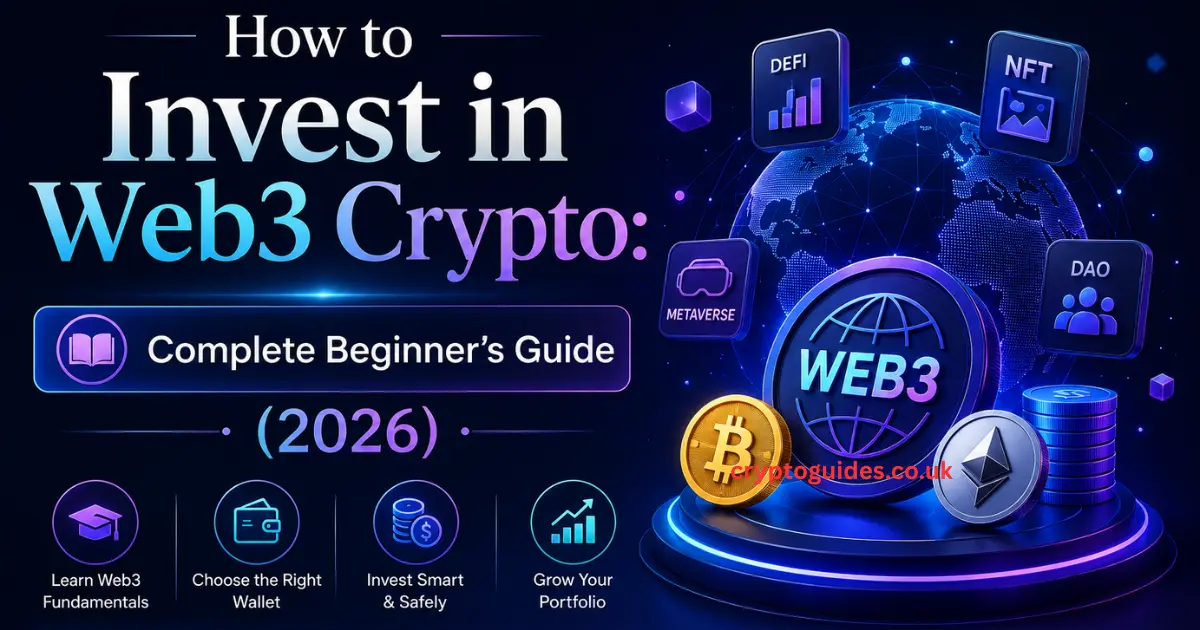
How to Invest in Web3 Crypto: Complete Beginner’s Guide (2026)
Introduction
Web3 crypto is the new generation of the internet built on blockchain technology. It allows people to own digital assets without banks or middlemen. Investing in Web3 crypto means buying these digital assets to grow your wealth.
What if you could invest in the future of the internet today? Thousands of people are already making money with Web3 crypto every single day. You don’t want to miss this opportunity while it is still early.
Web3 crypto includes coins, tokens, NFTs, and decentralized finance projects. You can start investing with a small amount of money from anywhere in the world. The market is growing fast and new projects are launching every week.
How to Invest in Web 3.0: A Comprehensive Guide
The internet is changing fast. What started as simple web pages in the 1990s has now evolved into something far more powerful. Today, we are standing at the edge of a brand-new digital era, and it is called Web 3.0. If you have been hearing about how to invest in web 3.0 and wondering where to begin, you are in the right place. This guide breaks everything down in simple, easy-to-understand language so that anyone, whether you are a complete beginner or a curious investor, can understand and take action.
Web3 investing is not just a trend. It is a movement. Trillions of dollars are being built on decentralized infrastructure right now, and smart investors are already positioning themselves for massive gains. The question is not whether Web3 will change the world. It already is. The real question is whether you will be part of it or watch from the sidelines.
This comprehensive guide covers everything from what Web 3.0 actually means to the best ways to invest in web 3.0, the risks involved, and how to protect yourself while growing your wealth in the web3 ecosystem. Let’s dive in.
What Is Web 3.0?
To understand web 3.0 investment, you first need to understand what Web 3.0 actually is. Most people use the internet every day without thinking about who controls it. Right now, a handful of giant corporations like Google, Meta, and Amazon control nearly everything you do online. They own your data, your content, and your digital identity. Web 3.0 changes all of that.
Web 3.0, often written as Web3, is the next generation of the internet. It is built on blockchain technology, which is a decentralized system that records information across thousands of computers simultaneously. Nobody owns the blockchain. Nobody can shut it down. It belongs to everyone who uses it. This is the core idea behind the decentralized internet, and it is why so many people are excited about it.
Think of it this way. Web 1.0 was like a library. You could read information, but you couldn’t interact or add anything. Web 2.0 was like a social platform where you could create content, but the platform owned it. Web 3.0 is like owning the entire building. You create content, you own it, and you earn from it directly without any middleman taking a cut.
Blockchain innovation is at the heart of this shift. Smart contracts, which are self-executing programs stored on the blockchain, allow transactions and agreements to happen automatically without the need for banks, lawyers, or any central authority. This opens up a world of web3 investment opportunities that simply did not exist before.
What’s the Difference Between Web 2.0 and Web 3.0?
Understanding this difference is critical before you invest in web3. The gap between these two versions of the internet is enormous, and it affects how money flows, who profits, and how you as an investor can benefit.
In Web 2.0, platforms like YouTube, Instagram, and Twitter make billions of dollars from your content and your attention. You create the value, but they capture the profit. In Web 3.0, value flows back to the users. Creators earn tokens. Participants get rewarded. Ownership is built into the system.
| Feature | Web 2.0 | Web 3.0 |
|---|---|---|
| Data Ownership | Platform owns your data | You own your data |
| Trust Model | Centralized servers | Decentralized blockchain |
| Monetization | Advertising revenue | Tokens and NFTs |
| Identity | Platform-controlled | Self-sovereign identity |
| Examples | YouTube, Twitter, Facebook | Mirror, OpenSea, Uniswap |
| Governance | Corporate decisions | Community voting (DAOs) |
| Payments | Banks and processors | Crypto wallets |
This table makes it clear that web3 crypto investments are not just about buying coins. You are investing in an entirely different economic system, one that puts power back in the hands of individuals.
Effective Strategies for Investing in Web 3.0
Now let’s get to the part you really came here for. Web3 investment strategies are not one-size-fits-all. Your best path depends on your risk tolerance, your technical knowledge, and how much time you want to spend managing your investments. The good news is that there are multiple ways to participate, from buying stocks in traditional brokerage accounts to diving deep into decentralized finance protocols.
Here is a broad look at the five main strategies covered in this section:
| Investment Strategy | Risk Level | Minimum to Start | Best For |
|---|---|---|---|
| Web3 Stocks | Medium | $1 | Traditional investors |
| Cryptocurrencies | High | $10 | All skill levels |
| NFTs | Very High | $50 | Creative and tech-savvy investors |
| DeFi Protocols | Very High | $100 | Experienced investors |
| DAOs | High | Varies | Community-oriented investors |
Each strategy has its own learning curve, its own rewards, and its own pitfalls. Let’s explore each one in depth.
Investing in Stocks With Web3 Exposure
If you are not ready to set up a crypto wallet or navigate blockchain platforms, web3 stocks are your best starting point. These are publicly traded companies that are either building Web3 infrastructure or benefiting directly from the growth of the blockchain industry. You can buy them through a regular brokerage account like Fidelity, Charles Schwab, or Robinhood, just like buying shares of Apple or Tesla.
Web3 companies like Coinbase (COIN) are among the most direct plays. Coinbase is the largest cryptocurrency exchange in the United States and earns revenue every time someone buys or sells crypto on its platform. As cryptocurrency investments grow in popularity, Coinbase’s revenue grows too. Another major player is NVIDIA, whose graphics processing units power the massive computing networks that blockchain and AI systems depend on. Then there is Block Inc., formerly Square, which integrates Bitcoin payments into its financial ecosystem.
Best web3 stocks to buy in 2026 also include companies like Riot Platforms and Marathon Digital, which are Bitcoin mining operations that profit directly when Bitcoin prices rise. Metaverse and augmented reality companies like Meta Platforms also qualify, since metaverse investments and augmented reality investments are deeply intertwined with the Web3 vision of a fully digital, immersive internet.
For US investors who want even more simplicity, blockchain-focused ETFs like the Amplify Transformational Data Sharing ETF (BLOK) or the Bitwise Crypto Industry Innovators ETF (BITQ) offer exposure to a basket of web3 companies without picking individual stocks. This is one of the safest ways to invest in web3 for complete beginners.
Exploring NFT Investment Opportunities
Few things in the Web3 world have captured mainstream attention quite like NFTs, and for good reason. NFT investments represent a genuinely new asset class, one built on the idea of provable digital ownership. An NFT, or Non-Fungible Token, is a unique digital item stored on the blockchain. It can be a piece of digital art, a music album, a gaming item, a membership pass, or even a deed to virtual land.
How to invest in NFTs is a question many beginners ask, and the process is simpler than most people expect. First, you need a digital wallet like MetaMask or Coinbase Wallet. Then you need to fund it with Ethereum, since most NFTs are bought and sold using ETH. From there, you visit a marketplace like OpenSea, Blur, or Magic Eden, browse available collections, and purchase the NFT you want. The transaction is recorded permanently on the blockchain, proving you are the owner.
What makes an NFT valuable? Three things matter most: utility, community, and scarcity. An NFT that gives you access to exclusive events, real-world products, or voting rights in a project has real utility. A project with a passionate, active community tends to hold its value better than one with a quiet Discord server. And scarcity, meaning a limited number of NFTs in a collection, drives up demand and price.
“NFTs are not just JPEGs. They are programmable assets with embedded rules, royalties, and rights. The technology is far deeper than the memes suggest.” — A widely shared sentiment among Web3 developers and investors in 2024.
However, honesty matters here. The NFT market is volatile. Many NFT projects have gone to zero. Web3 investment risks and rewards are nowhere more visible than in the NFT space. The reward potential is massive, but so is the risk of loss. Always research before you buy, check the project’s team, roadmap, and community size, and never invest money you cannot afford to lose.
Navigating Cryptocurrency Investments in Web 3.0
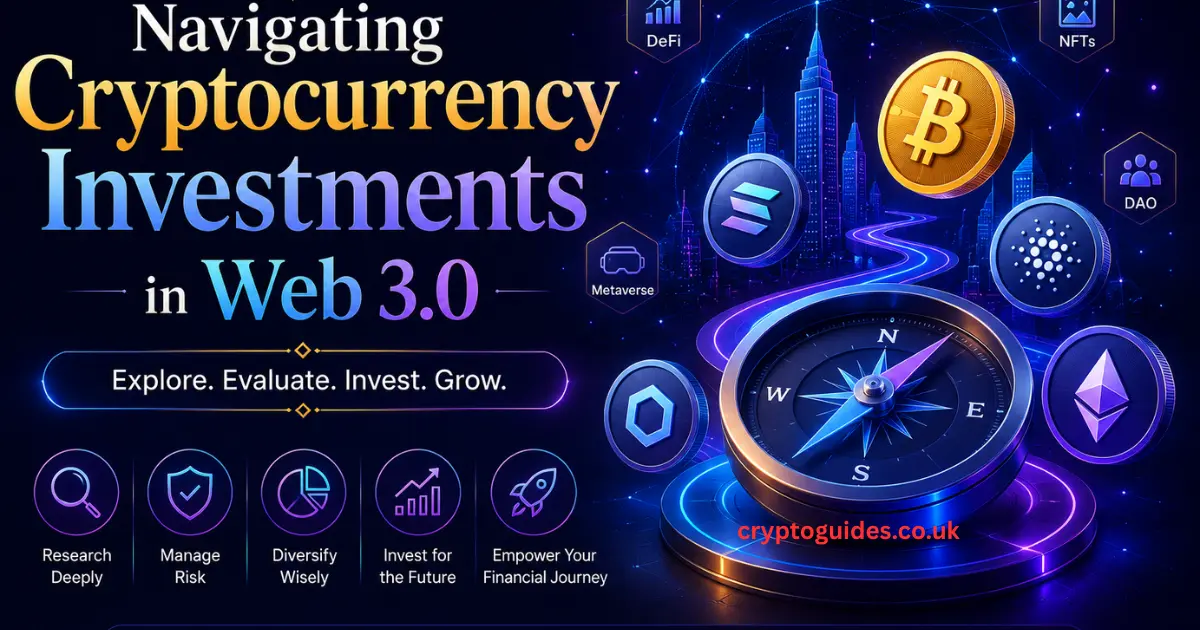
Cryptocurrency investments are the most direct and widely known form of web3 investing. When most people think about investing in Web3, they think about buying coins. And they are right to think that way, because crypto is the fuel that powers the entire Web3 engine.
The top web3 crypto investments to consider in 2026 include Ethereum (ETH), which is the backbone of most Web3 applications. Nearly every major dApp, DeFi protocol, and NFT marketplace runs on Ethereum or one of its Layer 2 networks. Solana (SOL) is another major player, known for its incredibly fast transaction speeds and low fees. Polkadot (DOT) connects multiple blockchains together, and Chainlink (LINK) provides real-world data to smart contract investments on the blockchain.
How to start investing in web3 through crypto is a straightforward process. You sign up on a regulated exchange like Coinbase, Kraken, or Binance US. You verify your identity using a government-issued ID, which is required by US law. You fund your account with dollars using a bank transfer or debit card. Then you buy the crypto of your choice and either leave it on the exchange or transfer it to your personal wallet for added security.
One of the smartest strategies for beginners is called Dollar-Cost Averaging, or DCA. Instead of putting all your money in at once and hoping you picked the right moment, you invest a fixed amount, say $50 or $100, at regular intervals, weekly or monthly, regardless of the price. This strategy smooths out the volatility and removes the stress of trying to time the market. For crypto portfolio diversification, spreading your money across several established coins, rather than putting everything into one, reduces your overall risk significantly.
Understanding the Risks of Web3 Investments
No honest web3 investment guide for beginners skips the risks. Web3 investment risks and rewards go hand in hand, and understanding the downside is just as important as chasing the upside.
The most obvious risk is market volatility. Crypto markets can drop 50%, 70%, or even 80% in a matter of weeks. This has happened multiple times throughout Bitcoin’s history. In 2022, the entire crypto market lost over two trillion dollars in value. If you are not emotionally and financially prepared for that kind of swing, you need to adjust your strategy accordingly.
Scams are another massive problem in the Web3 space. Rug pulls happen when a project team raises millions of dollars from investors and then disappears overnight, taking all the money with them. Phishing attacks trick you into giving up your wallet password or seed phrase. Fake token launches promise massive returns but deliver nothing. The US Federal Trade Commission reported that consumers lost over $1 billion to crypto scams in 2022 alone, and the numbers have only grown since then.
Regulatory uncertainty is another critical risk factor. The US Securities and Exchange Commission (SEC) has been increasingly active in regulating crypto assets. Some tokens could be classified as securities, which would dramatically change how they can be bought, sold, and traded. Staying informed about US crypto regulations is essential for any serious investor.
Finally, there is smart contract risk. Even well-audited code can have bugs. Hackers have stolen billions of dollars by exploiting vulnerabilities in smart contract investments and DeFi protocols. Tools like CertiK and Hacken audit smart contracts for security, and checking whether a project has been audited is a basic but powerful step in your research process.
Benefits and Reasons to Invest in Web3 Crypto
Despite the risks, the reasons to invest in web3 are compelling. The potential upside is extraordinary, and the structural shift happening in technology and finance makes this one of the most significant investment opportunities of the decade.
First, you are early. Most Americans still do not own any crypto. Web3 applications are still being built. The infrastructure is still young. Being early in a technology revolution is how generational wealth is created. Think about those who invested in Amazon in 1997 or bought Apple shares before the iPhone. Blockchain investing in 2026 is similar in terms of timing relative to where the technology is heading.
Second, the return potential of crypto market opportunities far exceeds traditional assets. While the stock market has historically returned around 10% annually, crypto assets have produced returns of 100%, 1,000%, and even higher in bull market years. Of course, the losses can be equally dramatic, which is why position sizing and diversification matter so much.
Third, Web3 opens up passive income streams that do not exist in traditional finance. Staking lets you lock up your crypto tokens and earn rewards automatically, similar to earning interest but at much higher rates. Yield farming through decentralized finance protocols can generate significant returns for those willing to learn how it works. These income streams are available to anyone with an internet connection, regardless of their income level or geographic location.
Fourth, digital asset investing gives you access to web3 projects that are reshaping entire industries, from healthcare and supply chain management to gaming and social media. Owning tokens in these projects means you participate directly in their growth and governance.
Key Considerations for Web3 Investments
Before you put a single dollar into any web3 investment, you need to think carefully about several key factors. Jumping in without preparation is one of the most common and costly mistakes beginners make.
Your risk tolerance is the first thing to evaluate honestly. Web3 is not the place for money you need in three months. It is volatile, unpredictable, and can swing wildly in either direction. Ask yourself: if my investment dropped 70% tomorrow, would I be okay? If the answer is no, you need to either reduce your position size or choose lower-risk options like web3 stocks instead of direct crypto.
Your time horizon matters enormously in blockchain investing. Short-term traders try to buy low and sell high within days or weeks. Long-term holders, often called HODLers in crypto culture, buy and hold for years regardless of short-term price movements. Research consistently shows that long-term holding beats active trading for most retail investors. If you plan to hold for five or more years, short-term volatility matters much less.
Tax implications are a serious consideration for US investors. The IRS treats cryptocurrency as property, not currency. This means every time you sell, trade, or use crypto, it is a taxable event. You need to track your cost basis, your sale price, and your gain or loss for every transaction. Tools like CoinTracker, Koinly, and TaxBit make this process much easier. Failing to report crypto gains can result in serious penalties, so this is not something to ignore.
| Key Consideration | Questions to Ask |
|---|---|
| Risk Tolerance | Can I handle a 70% drop without panic selling? |
| Time Horizon | Am I holding for 1 year or 5+ years? |
| Security | Is my seed phrase stored safely offline? |
| Tax Compliance | Am I tracking every transaction for the IRS? |
| Research | Have I read the whitepaper and checked the team? |
| Diversification | Am I spreading risk across multiple assets? |
Security is non-negotiable in web3 crypto investments. Your seed phrase, the 12 or 24 words given to you when you create a wallet, is the master key to all your assets. Anyone who has it can take everything. Write it down on paper. Store it somewhere fireproof. Never type it into any website or share it with anyone, ever. Hardware wallets like Ledger and Trezor store your private keys offline, making them immune to online hacking attempts.
Who Should Invest in Web 3.0?
Web3 investing is genuinely accessible to a wide range of people, but it is not right for everyone. Knowing whether you fit the profile of an ideal Web3 investor can save you a lot of money and stress.
Tech-savvy millennials and Gen Z investors who already live digital lives are natural fits for how to invest in web 3.0. They are comfortable with apps, digital wallets, and online transactions. The learning curve feels natural rather than intimidating. Many of them are already using platforms that are built on or adjacent to Web3 infrastructure.
Traditional investors who want to diversify their portfolios beyond stocks and bonds can benefit significantly from adding a small allocation of crypto portfolio diversification assets. Financial advisors increasingly recommend anywhere from 1% to 5% of a portfolio in crypto assets as a hedge against inflation and currency devaluation. Even a small position can meaningfully improve overall portfolio returns if the market performs well.
Entrepreneurs and builders are perhaps the most ideally positioned for Web3. Those with technical, marketing, or community-building skills can get involved directly by working for web3 startups, contributing to open-source projects, or even launching their own Web3 ventures. The web3 ecosystem is hungry for talent, and contributing to it can be both financially rewarding and personally fulfilling.
On the other hand, people carrying high-interest debt, those without an emergency fund, or those who are deeply risk-averse should probably wait or limit their exposure to the lowest-risk options available. Investing in Web3 while financially vulnerable is a recipe for disaster. The golden rule of investing applies here more than anywhere else: only invest what you can afford to lose completely.
Can You Invest Directly In Web 3.0?
Absolutely yes. Direct web3 investing means you are interacting with the blockchain itself, not going through a traditional broker or stock exchange. This is where the real potential lies, and it is more accessible than most people think.
The starting point is always a digital wallet. MetaMask is the most popular choice for beginners. It works as a browser extension and a mobile app. Coinbase Wallet and Trust Wallet are also excellent options. Setting one up takes less than ten minutes. Once your wallet is ready, you fund it by purchasing Ethereum or another cryptocurrency on an exchange and sending it to your wallet address.
From there, the entire Web3 world opens up to you. You can buy NFT investments on OpenSea. You can provide liquidity on Uniswap and earn trading fees. You can stake tokens on Ethereum and earn annual rewards. You can vote on governance proposals in DAOs. Every one of these actions puts you directly inside the web3 ecosystem, not just observing it from the outside.
One thing every beginner needs to understand is gas fees. On the Ethereum network, every transaction requires a small fee paid in ETH, called a gas fee. These fees fluctuate based on network congestion. During busy periods, gas fees can be surprisingly high. To minimize this, many investors use Ethereum Layer 2 networks like Polygon, Arbitrum, or Optimism, which offer the same functionality at a fraction of the cost.
How to invest in blockchain technology directly is a question that essentially comes down to this: choose a wallet, choose a reputable exchange, buy your chosen assets, and learn how to use decentralized applications. Start small. Experiment. The learning process itself is part of the value.
Is Investing in Web 3.0 Safe?
Let’s be completely honest here. Web3 investment risks and rewards are both real and significant. Web3 investing is not safe in the same way that putting money in a savings account is safe. But neither is it reckless gambling if you approach it with knowledge and discipline.
The biggest safety factors are within your control. Using regulated, reputable exchanges like Coinbase or Kraken gives you legal protections and insurance on your deposited funds. Storing your assets in a cold wallet, meaning a hardware device not connected to the internet, eliminates the risk of online hacks. Diversifying across multiple assets means a single project failing does not wipe out your entire portfolio.
Red flags to avoid are equally important. Anonymous development teams with no verifiable identities are a major warning sign. Projects with no whitepaper, which is a document explaining the technology and economic model, are not serious. Anyone promising guaranteed returns or risk-free profits in crypto is lying. The Web3 space has more than its share of scammers, and staying skeptical protects your money.
Regulation in 2026 is actually making the space safer for US investors than it was even two years ago. Clearer guidelines from the SEC and CFTC on which tokens qualify as securities, combined with growing institutional adoption, have brought more legitimacy and oversight to the market. This does not eliminate risk, but it does reduce the wild-west lawlessness that characterized early crypto markets.
The bottom line is this: managed risk is not the same as danger. Millions of Americans invest in stocks knowing they can lose money. Web3 investment is the same concept applied to a newer, faster-moving market. Respect the risk, educate yourself, and invest accordingly.
What is Web3?
Web3 is a word you are hearing more and more, and for good reason. It describes the next evolution of the internet, built on a foundation of blockchain technology, decentralization, and user ownership. But to really understand what Web3 is and why it matters for investors, you need to look at where it came from and where it is going.
What Does Web3 Mean?
At its core, Web3 means an internet where users, not corporations, are in control. Every piece of data you create, every asset you own, every transaction you make is stored on a decentralized blockchain that no single entity controls. This is the opposite of how the internet works today, where your data lives on corporate servers that can be sold, censored, or deleted without your consent.
Smart contract investments are central to how Web3 functions. A smart contract is a piece of code that runs on the blockchain and executes automatically when certain conditions are met. For example, a smart contract can automatically release payment to a freelancer when they submit a completed project, without any bank, PayPal, or middleman involved. This kind of trustless automation is what makes Web3 so powerful and why blockchain innovation is attracting billions in investment capital.
A useful analogy: if Web 2.0 is renting an apartment where the landlord makes all the rules, Web3 is owning your home outright. The deed is on the blockchain. Nobody can evict you. Nobody can change the terms. You are fully in control of your digital life and your digital assets.
How Did Web3 Get Started?
The story of Web3 begins with Bitcoin. When Satoshi Nakamoto launched Bitcoin in 2009, the idea was simple but revolutionary: create a digital currency that could be transferred between people without any bank or government involvement. Bitcoin proved that blockchain technology could secure financial transactions without a central authority.
But it was Vitalik Buterin who truly launched the Web3 era. In 2015, Buterin released Ethereum, a blockchain that could run programmable smart contracts. Suddenly, the blockchain was not just a ledger for recording transactions. It was a platform for building entire applications, financial systems, and digital economies. The term Web3 was coined by Ethereum co-founder Gavin Wood, who used it to describe this vision of a decentralized internet.
From 2015 onward, the Web3 movement grew rapidly. Decentralized finance protocols launched in 2018 and 2019, allowing people to borrow, lend, and earn interest without banks. NFTs exploded in popularity in 2021. Metaverse investments and virtual worlds built on blockchain gained mainstream attention. By 2026, Web3 has evolved from an experimental concept into a multi-trillion-dollar industry reshaping finance, gaming, art, and governance.
What is the Web3 Ecosystem?
The web3 ecosystem is vast and interconnected, and understanding its structure helps you make smarter investment decisions. Think of it like a city. The blockchains, such as Ethereum, Solana, and Avalanche, are the roads and infrastructure. The decentralized applications, known as dApps, are the businesses and services built on top of those roads. The tokens are the currency that makes the economy flow.
At the foundation, you have Layer 1 blockchains. These are the base networks where everything is recorded. Ethereum is the most widely used Layer 1 for Web3 applications. Solana is known for its speed. Avalanche is known for its flexibility. These Layer 1 blockchains compete for developers, users, and investment capital, much like cities compete for businesses and residents.
On top of Layer 1s, you have Layer 2 solutions. These are networks built on top of Ethereum that handle transactions faster and cheaper, then batch them back to the main Ethereum blockchain for security. Polygon, Arbitrum, and Optimism are the leading Layer 2 networks. They are essential for scaling Web3 to millions of users without prohibitive transaction costs.
Then come the applications. Decentralized finance platforms like Uniswap, Aave, and Compound allow people to trade, lend, and borrow without banks. NFT marketplaces like OpenSea and Blur allow digital asset investing in unique blockchain-based collectibles. Gaming platforms built on Web3 allow players to truly own their in-game items and sell them to other players for real money. DAOs allow communities to collectively govern shared treasuries and make decisions through token voting.
Understanding this layered structure helps you identify where the value is being created and where the best web3 investment opportunities might lie in 2026 and beyond.
What Are the Latest Trends in Web3?

The Web3 space moves at an extraordinary pace. Staying on top of the latest developments is not just interesting, it is essential for making good investment decisions. Here are the three most significant trends shaping web3 investing in 2026.
Crypto-Friendly Regulation
For years, regulatory uncertainty was one of the biggest barriers to mainstream Web3 adoption in the United States. That is changing rapidly. The SEC and CFTC have been developing clearer frameworks for classifying and regulating digital assets, and the approval of Bitcoin ETFs in early 2024 was a watershed moment that opened the floodgates to institutional investment.
By 2026, crypto-friendly regulation has become a competitive advantage for the United States. States like Wyoming, Texas, and Florida have passed legislation specifically designed to attract web3 companies and web3 startups. This regulatory clarity makes how to invest in web3 crypto significantly less risky than it was just a few years ago, because investors now have stronger legal protections and clearer rules for reporting and taxation.
Increased Investment
Institutional money is flooding into Web3 at a pace that would have seemed impossible in 2020. Venture capital firms like Andreessen Horowitz (a16z) have dedicated multi-billion-dollar funds specifically to Web3 and crypto investments. Sequoia Capital, Paradigm, and Pantera Capital are equally active. On the corporate side, Google, JPMorgan, Fidelity, and Visa are all building Web3 products and investing in blockchain innovation.
This institutional involvement is enormously significant for retail investors. When billion-dollar institutions put money into a sector, they bring credibility, infrastructure, and stability. They also do the deep due diligence that helps separate legitimate web3 projects from scams. Following institutional investment flows is one of the most effective strategies for identifying the best web3 crypto investment opportunities.
Web3 and AI
Perhaps the most exciting trend of 2026 is the convergence of AI and blockchain. Artificial intelligence and Web3 are not competing technologies. They are increasingly complementary ones. AI agents, which are software programs that can take autonomous actions on the internet, are beginning to operate on blockchain networks. These AI agents can manage crypto portfolios, execute smart contract investments, negotiate deals, and interact with dApps without human intervention.
Projects like Fetch.ai and Ocean Protocol are building decentralized AI marketplaces where data and AI models can be bought and sold using tokens. Blockchain technology investments in the AI space represent some of the most exciting crypto market opportunities available today. The combination of decentralized infrastructure and artificial intelligence intelligence is creating entirely new categories of investment that did not exist even two years ago.
How to Invest in Web3
Now let’s get practical. How to start investing in web3 is a question with a clear, step-by-step answer, regardless of your starting point. Here are the three primary paths available to US investors today.
Cryptocurrencies
Cryptocurrency investments are the most direct and liquid way to participate in the Web3 economy. Here is exactly how to get started:
Step 1: Choose a regulated US exchange. Coinbase is the best choice for most beginners because it is publicly traded, regulated, and insured. Kraken is another excellent option with a wider selection of coins. Gemini is popular among security-focused investors.
Step 2: Create and verify your account. You will need to provide your email, create a password, and verify your identity with a government-issued ID. This process usually takes 10 to 30 minutes.
Step 3: Fund your account. Link your bank account and transfer dollars. Most exchanges allow purchases starting at as little as $2.
Step 4: Buy your chosen cryptocurrency. For beginners, Ethereum (ETH) is the most widely recommended starting point because it is the backbone of the Web3 ecosystem.
Step 5: Decide where to store it. For small amounts, leaving it on the exchange is acceptable. For larger amounts, move it to a personal hardware wallet for maximum security.
Stocks
Web3 stocks vs crypto is a common debate among investors, and the honest answer is that both have a place in a well-diversified portfolio. Best web3 stocks to buy in 2026 include Coinbase (COIN), which earns revenue directly from crypto trading volume. NVIDIA (NVDA) supplies the chips that power blockchain networks, AI systems, and virtual reality environments. Block Inc. (SQ) integrates Bitcoin payments into its point-of-sale and Cash App ecosystems. Riot Platforms (RIOT) and Marathon Digital (MARA) are pure-play Bitcoin miners.
These stocks can be purchased through any standard brokerage account. Fidelity, Charles Schwab, TD Ameritrade, and Robinhood all allow you to buy these shares. You do not need a crypto wallet, a seed phrase, or any technical knowledge beyond knowing how to place a stock order.
NFTs
NFT investments require a bit more technical setup but offer unique exposure to the creative and cultural side of Web3. How to invest in NFTs breaks down into five clear steps.
First, install MetaMask as a browser extension and create your wallet. Second, buy Ethereum on Coinbase and send it to your MetaMask wallet address. Third, visit OpenSea or Magic Eden and browse collections. Fourth, research the projects you are interested in by reading their website, checking their Twitter following, and looking at their Discord community. Fifth, purchase the NFT you want and it will appear in your wallet automatically.
The key to successful NFT investments is research. Look for projects with real utility, active communities, and transparent teams. Avoid hype-driven launches with anonymous founders and promises of overnight wealth.
Can I Invest in Web3 if I Don’t Have Money?
This is one of the most common questions beginners ask, and the answer is genuinely encouraging. You do not need a large amount of money to start building exposure to the web3 ecosystem. There are several legitimate ways to get started with zero or minimal capital.
Find a Job With a Web3 Company
Web3 startups and established web3 companies are hiring aggressively right now. Developers, designers, community managers, writers, marketers, and project managers are all in high demand. Many Web3 companies pay partly or fully in cryptocurrency, which means your salary itself becomes your investment.
Platforms like Web3.career, Cryptocurrency Jobs, and LinkedIn’s Web3 job listings are excellent places to start your search. Remote work is extremely common in Web3, which means your location in the US is not a limiting factor. Getting paid in crypto is one of the most natural ways to build a digital asset investing portfolio without spending any extra money.
Play Cryptocurrency Games
Play-to-earn gaming is a genuine Web3 phenomenon. Games like Gods Unchained and Splinterlands reward players with crypto tokens and NFTs that have real monetary value. You play the game, you earn digital assets, and you can sell those assets on open marketplaces. The earnings are typically modest for casual players, but for dedicated gamers who master the mechanics, the income can be meaningful.
Be realistic about expectations here. Play-to-earn gaming is not a get-rich-quick scheme. It requires time, skill, and sometimes an initial investment to get started. But as a way to learn about web3 investing while earning small amounts of crypto, it is one of the most engaging entry points available.
Use a Cryptocurrency Browser
Brave Browser is a privacy-focused web browser that pays users in Basic Attention Token (BAT) simply for browsing the internet and viewing privacy-respecting ads. Setting up Brave takes less than five minutes. You download it, enable ads in your settings, and start earning BAT automatically as you browse. The earnings are small, but the point is that you start accumulating a real cryptocurrency without spending anything at all.
This is one of the most frictionless introductions to cryptocurrency investments available. Once you have earned your first few dollars of BAT, you can convert it to other cryptocurrencies and begin exploring the broader Web3 world with money you earned rather than spent.
Can I Passively Invest in Web3?
Passive web3 investing is not just possible. It is one of the smartest approaches for busy investors who want exposure to the upside without spending hours monitoring charts and researching projects every day.
Staking is the most popular passive income strategy in Web3. When you stake a cryptocurrency, you lock it in a smart contract to help secure the network, and in return you earn staking rewards, which are paid out in the same cryptocurrency. Ethereum currently offers staking yields that vary based on network conditions. Solana, Cardano, and Polkadot also offer staking rewards. Many exchanges, including Coinbase and Kraken, allow you to stake directly from the platform without any technical setup.
Decentralized finance protocols offer more advanced passive income through yield farming and liquidity provision. On a platform like Uniswap, you can deposit two tokens into a liquidity pool and earn a percentage of every trading fee generated by that pool. Annual percentage yields in DeFi can be significantly higher than traditional savings accounts, though the risks are correspondingly higher as well.
Crypto savings accounts through platforms like Nexo and Coinbase Earn offer another layer of passive income. You deposit your crypto and earn interest over time, similar to a savings account but with higher rates. These rates fluctuate with market conditions, but they consistently outperform traditional bank interest rates for those comfortable holding crypto long-term.
Automating your purchases through Dollar-Cost Averaging is the simplest passive strategy of all. Most major exchanges allow you to set up recurring purchases, buying a fixed dollar amount of your chosen crypto on a weekly or monthly schedule, without any active involvement on your part.
What Are Potential Risks of Web3 Investing?
No beginner guide to web3 investing is complete without a thorough discussion of risk. The Web3 space is genuinely exciting, but it is also genuinely dangerous for unprepared investors. Here is what you need to know.
Smart contract risk is one of the most technically unique risks in blockchain investing. Smart contracts are code, and code can have bugs. When a bug is exploited by a hacker, funds can be stolen instantly with no recourse. The Ronin Network hack in 2022 resulted in $625 million being stolen. The Poly Network hack in 2021 cost $611 million. Even well-audited protocols have been exploited. Always check whether a project’s smart contracts have been independently audited before investing.
Market manipulation is another real concern. Large holders, called whales, can move prices significantly by buying or selling large amounts of a token. Pump-and-dump schemes, where a group coordinates to artificially inflate a token’s price before selling and crashing it, are unfortunately common in smaller web3 projects. Sticking to established, high-liquidity assets significantly reduces this risk.
Emotional investing destroys more portfolios than any hack or scam. FOMO, the fear of missing out, causes people to buy at the top of a market cycle. Panic selling causes people to sell at the bottom. The solution is a written investment plan that you commit to before buying anything. Define your entry points, your exit strategy, and your maximum loss tolerance before emotions enter the picture.
Regulatory risk remains significant in 2026, even with clearer rules than before. A single SEC enforcement action or Congressional hearing can cause significant market drops. Staying informed about US crypto policy through reliable sources like CoinDesk, The Block, and official SEC announcements is a basic part of responsible web3 investment.
Why Web3 Is an Investment Opportunit
The numbers are staggering. The global blockchain technology investments market was valued at over $17 billion in 2023 and is projected to reach hundreds of billions by the end of the decade. Venture capital firms poured over $30 billion into Web3 startups in 2022 alone, even during a severe crypto market downturn. When smart money keeps flowing into a sector during a bear market, it is worth paying close attention.
The historical comparison that resonates most is the early internet. In 1994, most people thought the internet was a toy for academics and technologists. By 2004, it had restructured commerce, communication, and media. By 2014, it had created Apple, Amazon, and Google as the most valuable companies on earth. Web3 is at a similar inflection point today. The infrastructure is being built. The users are arriving. The applications are launching. Being early is the advantage.
US-specific opportunity is also significant. Regulatory clarity in 2026 has made the United States one of the most attractive markets in the world for web3 investment. American investors have access to regulated exchanges, legal protections, and a growing ecosystem of Web3 financial products including ETFs, retirement accounts with crypto exposure, and institutional custody solutions.
Main Ways to Invest in Web3
Drawing together everything in this guide, here is a clean summary of the main web3 investment opportunities available to you right now.
| Method | Risk Level | Minimum Investment | Best For | Key Examples |
|---|---|---|---|---|
| Crypto Tokens | High | $10 | All investors | ETH, SOL, BTC, DOT |
| Web3 Stocks | Medium | $1 | Traditional investors | COIN, NVDA, MARA |
| NFT Investments | Very High | $50 | Creative investors | OpenSea, Blur |
| DeFi/Yield | Very High | $100 | Experienced investors | Uniswap, Aave |
| DAOs | High | Varies | Community investors | MakerDAO, Nouns |
| Blockchain ETFs | Medium-Low | $1 | Passive investors | BLOK, BITQ |
Each of these methods gives you meaningful exposure to the web3 ecosystem while suiting different levels of risk tolerance and technical sophistication. The best web3 investment strategies typically combine two or three of these approaches for balanced crypto portfolio diversification.
Risks of Web3 Investing
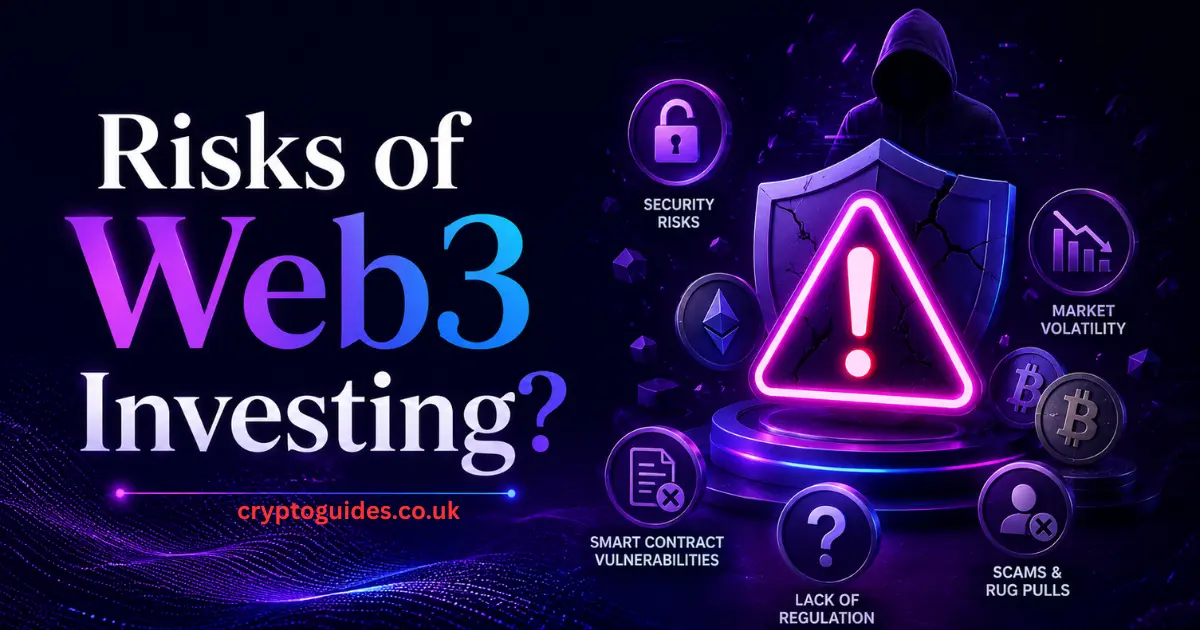
Web3 investment risks and rewards have been discussed throughout this guide, but it is worth bringing the key risks together in one place for clarity.
Volatility is the most immediate risk. Cryptocurrency investments can drop dramatically in short periods. Price swings of 20% to 50% in a single week are not unusual. NFT investments can become essentially illiquid during market downturns, meaning you cannot sell even if you want to.
Technology risk includes smart contract bugs, protocol failures, and the possibility that a particular blockchain technology becomes obsolete as superior alternatives emerge. The web3 ecosystem is evolving rapidly, and today’s leading platform could be replaced by something better within a few years.
Human risk includes the scams, rug pulls, and fraudulent projects that unfortunately populate the Web3 landscape. Always verify team identity, audit status, and community legitimacy before investing in any project.
Regulatory risk remains a factor even in 2026. A hostile regulatory environment could restrict certain types of web3 crypto investments or force US exchanges to delist specific tokens with little warning.
How to Invest Safely in Web3
Safest ways to invest in web3 come down to five core principles that every experienced investor follows.
Use only regulated, reputable exchanges for buying and selling. Coinbase, Kraken, and Gemini are all registered with US regulatory bodies and carry insurance on deposited funds. Avoid offshore exchanges with no US presence or regulatory compliance.
Secure your assets with a hardware wallet. For any significant amount of crypto, a Ledger or Trezor device is essential. These devices store your private keys offline, making them immune to online attacks. The cost is $60 to $150, which is trivial compared to the protection they provide.
Diversify your holdings across multiple assets, strategies, and time horizons. Do not put everything into a single coin, a single NFT project, or a single DeFi protocol. Crypto portfolio diversification is as important in Web3 as stock diversification is in traditional investing.
Stay educated. The Web3 space changes faster than any other market. Following reputable sources like CoinDesk, Decrypt, and The Block, as well as the official channels of any projects you invest in, keeps you informed and reduces the chance of being caught off guard by market developments.
Start small and scale up. Your first investment in Web3 should be an amount you are comfortable losing completely, not because you expect to lose it, but because that mindset protects you from emotional decision-making. As you learn and gain confidence, you can increase your position size strategically.
Business Perspective: Building for Web3
For entrepreneurs, web3 investing does not have to mean only buying tokens and waiting for prices to rise. Building in the Web3 space is itself a form of investment, one that can yield extraordinary returns for those with the skills and vision to execute.
Web3 startups are launching every week across sectors including finance, gaming, healthcare, supply chain, and social media. Entrepreneurs who identify a real-world problem that blockchain technology can solve better than existing solutions are positioned for massive success. The web3 ecosystem rewards genuine innovation with community support, venture funding, and token appreciation.
Grant opportunities are plentiful for builders in Web3. The Ethereum Foundation, Solana Foundation, and numerous DAOs run grant programs that provide non-dilutive funding to developers building on their platforms. This means you can get paid to build a Web3 project without giving up equity or taking on debt.
US businesses are also increasingly integrating Web3 tools into their existing operations. Accepting crypto payments, launching NFT-based loyalty programs, and using blockchain for supply chain verification are all practical applications that companies of every size are exploring. Token investing in the tools and platforms that enable these integrations represents another angle of opportunity for forward-thinking investors and entrepreneurs.
Trade Every Market in One Place
For US investors looking to manage all their web3 crypto investments alongside traditional assets like stocks, ETFs, and commodities, having a unified platform is a major advantage. The best modern trading platforms now allow you to move seamlessly between cryptocurrency investments, web3 stocks, and traditional markets from a single dashboard. This kind of integrated access makes crypto portfolio diversification dramatically easier and allows you to respond quickly to market opportunities across all asset classes.
Understanding the Disruptive Potential of Web3
Web3 is not simply a better version of the current internet. It is a fundamentally different system with the potential to restructure entire industries in ways that create enormous wealth for early investors and catastrophic disruption for those who resist the change. Understanding this disruptive potential is the foundation of making smart blockchain technology investments.
The financial industry faces the most immediate disruption. Decentralized finance platforms already allow anyone to borrow, lend, trade, and earn interest without a bank account. This is not a distant future scenario. Billions of dollars are already flowing through DeFi protocols every day. Banks and financial institutions that fail to adapt to this reality face existential pressure from protocols that offer better rates, lower fees, and 24/7 availability.
Gaming is another industry being completely rebuilt by Web3. Traditional games are a $200 billion industry where players spend real money on virtual items that they never truly own. Web3 gaming flips this model entirely. Players own their items as NFTs, can sell them freely on open marketplaces, and can earn crypto rewards for their time and skill. The economic model of gaming is changing permanently, and digital asset investing in Web3 gaming projects gives you exposure to this transformation.
Social media, supply chain management, healthcare data, and real estate are all industries being explored and disrupted by Web3 applications. The blockchain innovation driving these changes is not speculative. It is happening right now, at scale, with real users and real economic activity.
Who Are the Biggest Investors in Web3?
Following the smart money is one of the oldest and most reliable strategies in investing. Knowing who the biggest players in web3 investing are, and what they are betting on, gives retail investors a significant informational advantage.
Andreessen Horowitz, known as a16z, is by far the most active and influential investor in the Web3 space. Their dedicated crypto fund has invested in Coinbase, Uniswap, OpenSea, and dozens of other foundational web3 companies. When a16z invests in a project, it signals serious due diligence has been done and institutional credibility is behind the venture.
Sequoia Capital has been increasingly active in web3 startups, participating in major funding rounds for Solana, FTX (before its collapse, which itself was an important lesson in risk management), and various DeFi protocols. Paradigm, a crypto-native venture fund, focuses exclusively on web3 investment opportunities and has backed some of the most technically sophisticated projects in the space.
On the corporate side, Fidelity Investments now offers Bitcoin ETFs and has been building crypto custody solutions for institutional clients. Google has invested in blockchain infrastructure projects through its venture arm. Visa and Mastercard are actively integrating crypto payment rails into their existing networks. JPMorgan has launched its own blockchain platform for inter-bank settlements. The pattern is unmistakable: the biggest names in traditional finance are not ignoring Web3. They are building within it.
Types of Web3 Investments You Can Choose From
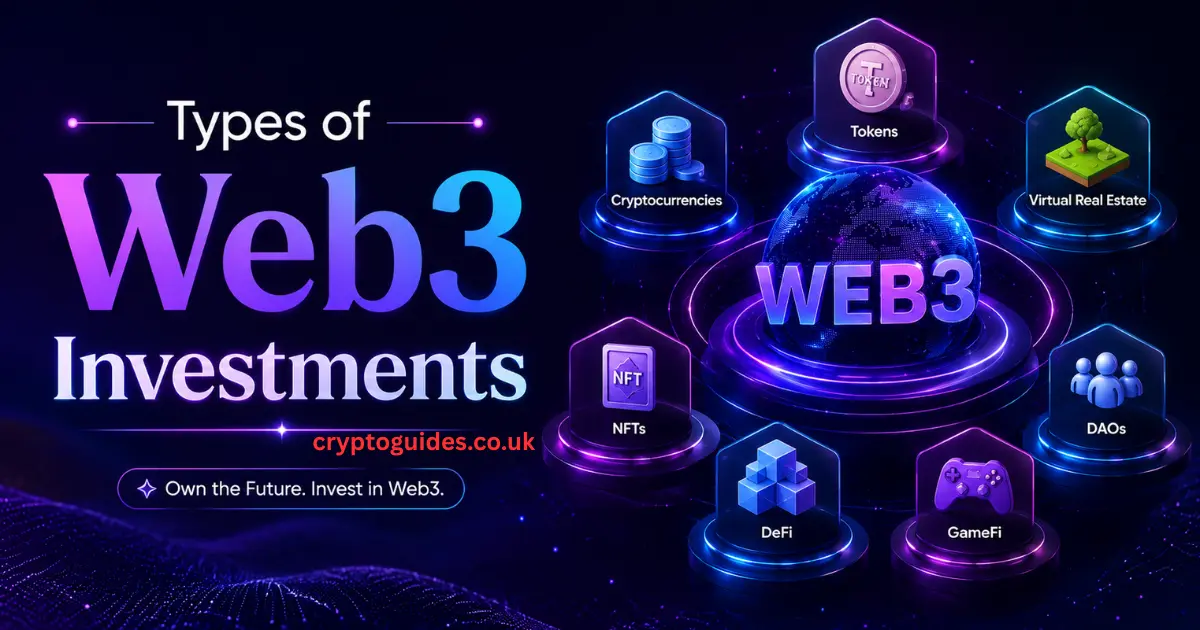
Invest in Cryptocurrencies
How to invest in blockchain technology most directly is through the native tokens of major blockchain networks. These are not just speculative assets. They are the fuel, governance tokens, and economic incentives that make entire networks function. When you buy ETH, you are buying a stake in the most widely used smart contract platform in the world. When you buy SOL, you are betting on a high-performance blockchain that is capturing significant developer and user attention.
Layer 1 blockchains represent the foundational investment opportunity. Ethereum, Solana, Avalanche, and Polkadot are competing to be the infrastructure layer of the Web3 internet, much like competing operating systems in the early days of personal computing. Layer 2 solutions like Polygon, Arbitrum, and Optimism represent the scaling layer that makes these networks usable at mass scale. Token investing in both categories gives you broad exposure to blockchain innovation.
DeFi tokens like Uniswap (UNI), Aave (AAVE), and Compound (COMP) give you exposure to specific financial protocols that are generating real revenue from real users. Researching tokenomics before buying DeFi tokens is essential. Look at the total supply, the distribution schedule, whether tokens give governance rights or revenue sharing, and what the actual utility of the token is within its ecosystem.
Invest in NFTs (Non-Fungible Tokens)
NFT investments in 2026 have matured significantly from the speculative frenzy of 2021. The projects that have survived and thrived are those with real utility, active communities, and transparent development teams. The focus has shifted from art collecting to membership, gaming items, and tokenized real-world assets.
Music NFTs are a growing category, allowing artists to sell songs directly to fans who own them and earn royalties from future plays and sales. Sports NFTs from platforms like NBA Top Shot give fans digital ownership of highlight moments. Real estate tokenization, where physical property is divided into NFT shares that anyone can buy, is one of the most exciting applications of digital asset investing in the coming years.
Tax rules for NFT investments in the USA are clear in principle but complex in practice. The IRS treats NFT sales as taxable events, and if you hold an NFT for more than a year before selling, you may qualify for long-term capital gains tax rates, which are lower than short-term rates. Keeping detailed records of every NFT purchase and sale price is essential for accurate tax reporting.
Invest in DAOs (Decentralized Autonomous Organizations)
DAOs represent one of the most innovative and potentially lucrative forms of web3 investment opportunities available. A DAO is an organization governed by smart contracts and community token votes rather than a traditional corporate hierarchy. Token holders vote on decisions ranging from treasury allocations to protocol changes.
MakerDAO governs the Dai stablecoin system, which backs billions of dollars of decentralized finance activity. Uniswap DAO controls one of the most profitable decentralized exchanges in the world. Nouns DAO generates revenue through daily NFT auctions and funds community-led creative projects. Investing in DAO governance tokens gives you both financial exposure and actual voting power in these organizations.
The risks of DAOs as investment vehicles are significant. Governance attacks, where a hostile party acquires enough tokens to pass malicious proposals, are a real threat. Low voter participation can allow small groups to make decisions that harm the broader community. Legal status of DAOs in the United States is still evolving, with some states like Wyoming formally recognizing them as legal entities while federal treatment remains unclear.
Some Risks and Considerations
The full spectrum of web3 investment risks and rewards demands honest, thorough consideration. The upside is real. The downside is equally real. Successful investors in Web3 are those who manage risk systematically rather than emotionally.
Building a personal risk framework before investing is not optional. It is the foundation of everything else. Your framework should define three things: how much of your total investable assets you will allocate to Web3 (most financial advisors suggest 1% to 10% depending on risk tolerance), how you will diversify within Web3 across different types of assets and strategies, and what your exit strategy is for both profit-taking and loss-cutting.
Psychological risk management is as important as financial risk management. Web3 crypto investments attract enormous media attention during bull markets, which creates massive FOMO pressure that leads investors to buy at exactly the wrong time. Building the habit of evaluating investments based on fundamentals rather than headlines is a skill that takes time to develop but pays dividends for your entire investing career.
Due Diligence: Research Before You Invest in Web3
How to invest in web3 crypto responsibly always starts with thorough research. The amount of information available about any legitimate Web3 project is substantial, and taking the time to review it properly separates good investments from expensive mistakes.
Every serious web3 project publishes a whitepaper, which is a document explaining the technology, the problem it solves, the economic model, and the team behind it. Reading the whitepaper of any project you are considering is not optional. If a project does not have a whitepaper, or if the whitepaper is vague and filled with buzzwords rather than technical substance, treat that as a serious red flag.
The team behind a project matters enormously. Look for publicly identified founders and developers with verifiable track records. Check their LinkedIn profiles, their previous projects, and whether they have any history of fraud or abandoned ventures. Anonymous teams are not automatically fraudulent, as Bitcoin itself was created by the pseudonymous Satoshi Nakamoto, but they do carry significantly higher risk.
On-chain data tools give you transparent insight into how a project is actually being used. Etherscan allows you to see every transaction on the Ethereum blockchain. Dune Analytics provides customizable dashboards showing user activity, revenue, and token flows for hundreds of protocols. Messari offers research reports and financial metrics for major crypto assets. These tools are free to use and give you information that most traditional financial markets cannot match in terms of transparency.
Conclusion: The Future of Web3 is Bright!
The journey through this comprehensive guide has covered an enormous amount of ground, from the foundational question of what Web3 actually is to the most practical details of how to invest in web3 crypto safely and intelligently. Let’s bring it all together.
Web3 represents the most significant restructuring of the internet since the invention of the World Wide Web itself. The shift from centralized, corporate-controlled platforms to decentralized, user-owned networks is not a speculative possibility. It is an ongoing reality with trillions of dollars, millions of users, and thousands of developers already committed to making it happen.
The web3 investment guide for beginners in this article has outlined multiple pathways for participation, from the relative safety of web3 stocks in a traditional brokerage account, to the higher risk and higher reward potential of direct cryptocurrency investments, NFT investments, and decentralized finance participation. There is a strategy here for every risk tolerance and every budget.
The risks are real and deserve respect. Volatility, scams, regulatory uncertainty, and smart contract vulnerabilities are all legitimate concerns that require active management. But risk managed intelligently is not a reason to stay on the sidelines. It is a reason to educate yourself, start small, diversify, and build your exposure gradually as your knowledge and confidence grow.
The internet changed everything once before. It created the biggest companies in human history and the greatest transfer of wealth that any generation has ever witnessed. Web3 investing is the next chapter of that story. The question is not whether Web3 will reshape the economy. The question is whether you will be positioned to benefit when it does.
Start today. Start small. Stay curious. The future of the internet is being built right now, and there is still time to be part of it.
Frequently Asked Questions
How much money do I need to start investing in Web3?
You can start with as little as $10 on most US cryptocurrency exchanges. Some platforms allow purchases starting at $2. For NFT investments, you typically need at least $50 to $100 to cover the cost of the NFT plus gas fees. There is no minimum for earning crypto through browsers or play-to-earn games.
Is Web3 crypto legal in the USA?
Yes, buying, selling, and holding cryptocurrency is completely legal in the United States. The IRS requires you to report crypto gains as taxable income. Regulations around specific tokens and activities continue to evolve, so staying informed about SEC and CFTC guidance is important.
What is the safest Web3 investment for beginners?
Web3 stocks like Coinbase, NVIDIA, or a blockchain ETF offer the lowest risk because they trade on regulated US stock exchanges and have the protections of traditional financial markets. Among direct crypto investments, Bitcoin and Ethereum are considered the safest due to their size, liquidity, and track record.
How do I pay taxes on Web3 crypto gains?
The IRS treats crypto as property. Every sale, trade, or spend is a taxable event. You report your capital gains or losses on Schedule D of your federal tax return. Tools like CoinTracker, Koinly, and TaxBit automatically generate your crypto tax reports by connecting to your exchange accounts.
Can I lose all my money in Web3?
Yes, you can. Especially with smaller altcoins, NFTs, and DeFi protocols, it is entirely possible to lose 100% of your investment. This is why position sizing and diversification are essential. Never invest more in Web3 than you can comfortably afford to lose entirely.
What if I invested $1,000 in Bitcoin 5 years ago?
If you had invested $1,000 in Bitcoin five years ago, your investment would have grown to anywhere between $5,000 and $15,000 depending on when exactly you bought and sold. Bitcoin has delivered extraordinary long-term returns despite its short-term volatility.
How to invest in Web3 blockchain?
You can invest in Web3 blockchain technology by buying Layer 1 tokens like ETH or SOL, purchasing blockchain stocks like NVIDIA or Coinbase, or investing in blockchain ETFs like BLOK. Start small, diversify across options, and always use a secure wallet.
Can you buy stock in Web3?
Yes, you can buy Web3-related stocks through any standard brokerage account. Companies like Coinbase, Riot Platforms, Marathon Digital, and NVIDIA all give you indirect exposure to Web3 growth without needing a crypto wallet.
Is $100 enough to invest in crypto?
Absolutely. Most exchanges let you start with as little as $10. With $100, you can build a small but real crypto portfolio across two or three coins. Use a Dollar-Cost Averaging strategy to grow it steadily over time without taking on too much risk at once.
This article is for informational purposes only and does not constitute financial advice. Always do your own research and consider consulting a qualified financial advisor before making investment decisions.

I am an SEO and Guest Posting expert with 5+ years of professional experience in building high-authority backlinks, strategic outreach, and scalable SEO campaigns, especially in the Crypto and Blockchain industry. Passionate about helping brands achieve sustainable organic growth, I specialize in guest posting, white-hat authority link building, content outreach, and digital PR strategies that enhance online credibility and search engine performance. Over the years, I have collaborated with international clients and global brands, delivering result-driven SEO solutions and placements on high-authority, high-DR websites focused on increasing organic traffic, domain authority, and online visibility in competitive markets.