Bitcoin Layer 2 Blockchain Mining: Complete Guide for Beginners (2026)
Bitcoin Layer 2 Blockchain Mining is a newer way to mine Bitcoin. It works on a second layer built on top of the main Bitcoin network. This method makes mining faster, cheaper, and more efficient than traditional mining.
Earning Bitcoin without paying huge electricity bills. Layer 2 mining is changing the game for everyday miners right now. This is your chance to get in before everyone else finds out.
By the time you finish reading, you’ll understand what Bitcoin Layer 2 blockchain mining is, how it works, what you need to get started, and how to avoid the costly mistakes most beginners make. Let’s dive straight in.
1. What Is Bitcoin Layer 2 Blockchain Mining?
Bitcoin Layer 2 blockchain mining is the process of participating in a second-level network built directly on top of the main Bitcoin blockchain. Think of it like this — the main Bitcoin blockchain is a busy motorway with thousands of cars all trying to travel at once. Traffic slows down and every driver pays a toll. Layer 2 blockchain technology builds an express lane above that motorway, moving traffic faster and at a fraction of the cost. Miners who work on this express lane are doing what we call Bitcoin Layer 2 blockchain mining.
The term “Layer 2” simply means a secondary framework that sits on top of Bitcoin’s base layer, known as Layer 1. While Layer 1 handles the final settlement and security of all transactions, Layer 2 protocols handle the heavy lifting in between — processing thousands of transactions off the main chain before bundling the results back onto Bitcoin’s ledger. This approach keeps the Bitcoin blockchain technology secure while solving its biggest weaknesses: speed and cost.
The Core Idea Behind Layer 2 Mining Simply Explained
Here’s the simplest way to think about it. Imagine you and your friends are buying rounds of drinks at a pub all night. Instead of paying the bartender after every single round, you keep a running tab and settle the total at the end of the night. Off-chain transactions work exactly the same way. Multiple transactions happen between parties without touching the main blockchain every single time. When you’re done, only the final balance gets recorded on the Bitcoin network. This saves time, saves money and keeps the Bitcoin network scalability intact. That’s the heart of Bitcoin Layer 2 blockchain mining explained in its most human form.
2. How Does Bitcoin Layer 2 Blockchain Mining Work?
Understanding how Bitcoin Layer 2 blockchain mining works starts with understanding the relationship between Layer 1 and Layer 2. The main Bitcoin blockchain — Layer 1 — uses a proof of work (PoW) system where mining nodes compete to solve complex mathematical puzzles. Whoever solves the puzzle first adds the next block and earns mining rewards. This system is brilliant for security but painfully slow for everyday transactions. Bitcoin Layer 2 blockchain mining takes a smarter approach.
When two parties want to transact using a Layer 2 protocol, they open what’s called a payment channel. They lock a small amount of Bitcoin into this channel as a deposit. From that point on, they can send transactions back and forth almost instantly — without ever touching the main blockchain. Each transaction updates a shared record between the two parties. When they’re ready to close the channel, only the final balances get submitted to the Bitcoin network for blockchain validation. This dramatically reduces congestion and slashes Bitcoin transaction fees for everyone involved.
The Role of Nodes in Bitcoin Layer 2 Blockchain Mining
Mining nodes play a crucial role in the Bitcoin Layer 2 ecosystem. On Layer 2, nodes don’t just validate blocks — they route transactions, manage payment channels and maintain network connectivity. Running a node on a Layer 2 blockchain is far less demanding than running a full Bitcoin mining operation on Layer 1. Here’s a clear comparison so you can see the difference instantly:
| Feature | Layer 1 Node | Layer 2 Node |
|---|---|---|
| Transaction Speed | ~7 transactions per second | Millions per second |
| Cost to Operate | Very high | Low to moderate |
| Energy Consumption | Extremely high | Minimal |
| Hardware Required | Industrial ASIC rigs | Standard laptop or Raspberry Pi |
| Technical Skill Needed | Advanced | Beginner-friendly |
| Earning Method | Block rewards + fees | Routing fees |
The difference is stark. Layer 2 crypto technology makes participation possible for everyday people — not just large mining corporations with warehouses full of machines.
3. Why Is Bitcoin Layer 2 Blockchain Mining Important?
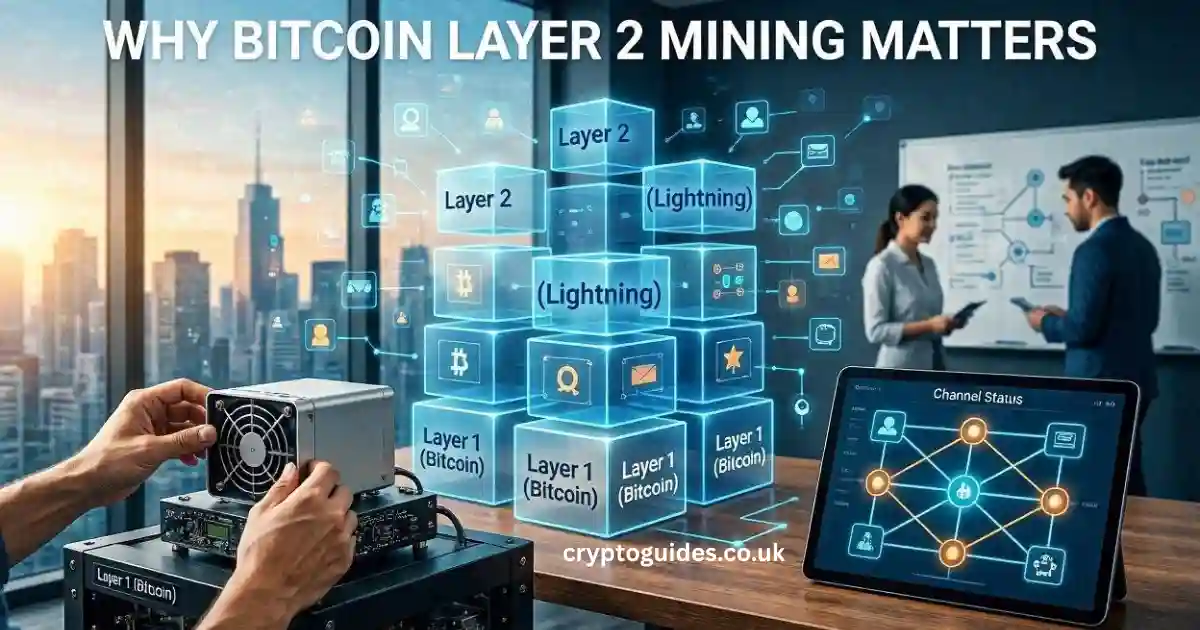
Bitcoin has a serious scalability problem, and most people don’t realise how severe it is. The Bitcoin network performance on Layer 1 maxes out at roughly 7 transactions per second. Compare that to Visa, which processes around 24,000 transactions per second. That gap is enormous. As Bitcoin grows in popularity across the UK, USA, and globally, this bottleneck becomes more painful. Bitcoin scaling solutions like Layer 2 exist precisely to close that gap without breaking what makes Bitcoin great in the first place.
Bitcoin Layer 2 blockchain mining is important because it keeps Bitcoin competitive. Without Layer 2, Bitcoin would struggle to function as a real-world payment tool. High Bitcoin transaction fees and slow Bitcoin transaction speed would push users toward faster alternatives. Layer 2 solves this by handling the bulk of transaction volume off-chain while keeping Bitcoin’s legendary Bitcoin blockchain security and decentralisation fully intact. For miners, this opens an entirely new income stream that doesn’t require industrial-scale operations.
Why Beginners in the UK and USA Should Care About Layer 2 Mining
For everyday people in the UK and USA, Bitcoin Layer 2 blockchain mining for beginners represents a genuinely accessible opportunity. You don’t need to spend tens of thousands of pounds or dollars on equipment. You don’t need a warehouse. You don’t need to pay enormous electricity bills every month. The barrier to entry is remarkably low compared to traditional Bitcoin mining. As the Bitcoin Layer 2 ecosystem grows, so does the income potential for node operators who get in early. The UK’s crypto-curious community and the USA’s rapidly expanding BTC ecosystem both stand to benefit enormously from embracing Layer 2 technology now rather than later.
4. Key Technologies Behind Bitcoin Layer 2 Blockchain Mining
The Lightning Network is the single most important technology powering Bitcoin Layer 2 blockchain mining today. Launched in 2018, the Lightning Network uses a system of payment channels and state channels to process Bitcoin transactions almost instantly. As of 2026, the Lightning Network has grown to tens of thousands of active nodes worldwide with a network capacity exceeding 5,000 BTC. It’s fast, it’s functional and it’s already being used by millions of people globally for real-world Bitcoin payments.
Beyond the Lightning Network, several other technologies support the Bitcoin Layer 2 blockchain mining landscape. Sidechains like the Liquid Network — developed by Blockstream — allow Bitcoin to move onto a separate blockchain with different rules, then return to the main chain. Rootstock (RSK) brings smart contracts on Bitcoin, essentially giving Bitcoin the programmability that made Ethereum famous. Rollups — while newer to Bitcoin — bundle hundreds of transactions into a single on-chain record, dramatically reducing load on the Bitcoin network scalability. BitVM is an emerging technology that pushes smart contracts on Bitcoin even further, opening the door to complex computation on the world’s most secure blockchain.
Lightning Network: The Engine of Bitcoin Layer 2 Blockchain Mining
The Lightning Network deserves special attention because it’s where most Bitcoin Layer 2 blockchain mining activity happens today. It works by creating a web of interconnected payment channels. When you want to send Bitcoin to someone you don’t have a direct channel with, the Lightning Network finds a route through other nodes automatically. Every node along that route earns a tiny routing fee. That’s how Bitcoin Layer 2 blockchain mining generates income — not through solving puzzles, but through facilitating the flow of value across the network. The more traffic your node routes, the more you earn. It’s elegantly simple once you see it in action.
5. Benefits of Bitcoin Layer 2 Blockchain Mining

Speed is the first and most obvious benefit. On the main Bitcoin blockchain, a transaction can take 10 minutes or longer to confirm. On the Lightning Network and other Layer 2 protocols, confirmation happens in seconds. That’s not a small improvement — it’s a fundamental transformation of how Bitcoin transaction speed works. For merchants in the UK and USA accepting Bitcoin payments, this makes all the difference between a practical payment tool and an impractical one.
Cost reduction is the second massive benefit. Bitcoin transaction fees on Layer 1 can spike to £20, £30 or even higher during busy periods. Off-chain transactions on Layer 2 cost a fraction of a penny. This alone makes Bitcoin Layer 2 blockchain mining an attractive option for anyone who wants to use Bitcoin seriously without watching their fees eat into their profits. For miners, lower overhead costs mean higher net earnings — and that’s a win by any measure.
Financial Benefits of Bitcoin Layer 2 Mining for UK and USA Miners
The financial case for Bitcoin Layer 2 blockchain mining is compelling, especially compared to traditional Bitcoin mining. Here’s a straightforward breakdown of what makes it financially attractive:
| Benefit | Traditional Mining | Layer 2 Mining |
|---|---|---|
| Startup Cost | £5,000 – £50,000+ | £100 – £500 |
| Monthly Energy Cost | £500 – £3,000+ | £5 – £30 |
| Earning Type | Block rewards | Routing fees |
| Break-Even Time | 12–24 months | 1–3 months |
| Accessibility | Experts only | Beginners welcome |
Beyond cost savings, there’s also an environmental dimension worth noting. Traditional proof of work (PoW) mining consumes staggering amounts of electricity. Bitcoin Layer 2 blockchain mining is dramatically greener, making it a more socially responsible choice — something that matters increasingly to UK and US communities conscious of carbon footprints.
6. Challenges of Bitcoin Layer 2 Blockchain Mining
Nothing worth doing comes without challenges, and Bitcoin Layer 2 blockchain mining is no exception. The biggest hurdle for most beginners is the technical learning curve. Setting up a Lightning Network node, managing payment channels, understanding liquidity and keeping your node online 24/7 requires patience and genuine effort. It’s not plug-and-play — at least not yet. However, tools like Umbrel and RaspiBlitz have made the setup process far more beginner-friendly than it was just two years ago.
Liquidity management is another real challenge. To route transactions on the Lightning Network, your node needs to have enough Bitcoin locked in its payment channels. If your channels run dry on one side, you can’t route transactions and you stop earning. Managing this balance — a process called channel rebalancing — takes time and strategy. On top of that, regulatory uncertainty in the UK under the Financial Conduct Authority (FCA) and in the USA under the Securities and Exchange Commission (SEC) means the rules around crypto mining activity can shift. Staying informed is not optional.
How to Overcome Common Challenges in Bitcoin Layer 2 Blockchain Mining
The good news is that every challenge in Bitcoin Layer 2 blockchain mining has a practical solution. For the technical learning curve, communities like the Lightning Network subreddit, the Umbrel community forums, and YouTube channels dedicated to Bitcoin Layer 2 solutions offer tremendous free support. For liquidity management, tools like Lightning Terminal and Rebalance-lnd automate much of the channel management work. For regulatory clarity, both UK and USA miners should consult resources from the FCA and the IRS respectively to understand their tax obligations and operating guidelines. None of these challenges are deal-breakers. They’re simply part of building a serious Layer 2 crypto technology operation.
7. Bitcoin Layer 2 Blockchain Mining vs Traditional Bitcoin Mining
The contrast between Bitcoin Layer 2 blockchain mining and traditional Bitcoin mining is dramatic. Traditional mining requires you to invest in powerful ASIC machines, pay for substantial electricity, manage heat and noise, and compete against massive mining pools with industrial-scale hash rates. Your chance of solo-mining a block and earning the full mining reward is statistically tiny unless you’re part of a large pool. It’s capital-intensive, energy-heavy and increasingly dominated by large corporations in countries with cheap electricity.
Bitcoin Layer 2 blockchain mining, on the other hand, doesn’t require you to solve any cryptographic puzzle at all. Instead of competing for block rewards, you earn routing fees by helping other people’s transactions move through the network. Your income depends on how much traffic flows through your node — and with the right setup and enough channel liquidity, you can earn consistently without the boom-and-bust unpredictability of traditional Bitcoin mining. The blockchain mining process on Layer 2 is fundamentally different in its mechanics, its costs and its accessibility.
Which Is Better for Beginners — Layer 2 or Traditional Bitcoin Mining?
For beginners in 2026, the answer is almost always Bitcoin Layer 2 blockchain mining. Here’s the complete side-by-side comparison:
| Factor | Traditional Bitcoin Mining | Bitcoin Layer 2 Blockchain Mining |
|---|---|---|
| Startup Cost | Very high (£10,000+) | Very low (£100–£500) |
| Energy Use | Extreme | Minimal |
| Technical Skill | Advanced | Beginner-friendly |
| Earning Speed | Slow and unpredictable | Steady and consistent |
| Scalability | Limited by hardware | Scales with liquidity |
| Environmental Impact | High carbon footprint | Near-zero footprint |
| Best For | Large-scale operations | Individual miners, beginners |
| Income Type | Block rewards | Routing fees |
That said, both approaches have their place in the broader BTC ecosystem. Traditional mining secures the base layer. Layer 2 mining makes it usable. Together, they make Bitcoin unstoppable.
8. Top Layer 2 Networks Supporting Bitcoin

The Bitcoin Layer 2 ecosystem has grown significantly and now includes several mature, battle-tested networks. The Lightning Network remains the dominant force, handling the vast majority of Layer 2 Bitcoin transactions globally. It’s fast, widely supported and has the largest developer community. For most beginners exploring Bitcoin Layer 2 blockchain mining, starting with the Lightning Network is the obvious choice.
The Liquid Network, developed by Blockstream, serves a different audience — primarily exchanges, traders and financial institutions that need fast, confidential Bitcoin transactions. Rootstock (RSK) brings smart contracts on Bitcoin into the picture, enabling decentralised applications and DeFi products built directly on the world’s most secure blockchain. The Stacks protocol goes further, enabling Bitcoin-native NFTs and decentralised apps while settling all activity back to Bitcoin’s main chain. And Ark Protocol — one of the newest and most exciting entrants — offers a novel approach to off-chain transactions that could reshape how Bitcoin Layer 2 blockchain mining works in the years ahead.
Which Layer 2 Network Is Best for Bitcoin Mining Beginners?
For anyone just starting their journey in Bitcoin Layer 2 blockchain mining, the Lightning Network is the undisputed starting point. It has the most documentation, the largest community, the most tools and the most routing opportunities. Here’s a quick reference for all five major networks:
| Network | Best For | Technical Level | Earning Method |
|---|---|---|---|
| Lightning Network | Payments, routing fees | Beginner | Routing fees |
| Liquid Network | Institutional trading | Intermediate | Transaction fees |
| Rootstock (RSK) | Smart contracts, DeFi | Advanced | Contract execution |
| Stacks | DeFi, NFTs on Bitcoin | Intermediate | Stacking rewards |
| Ark Protocol | Next-gen off-chain payments | Beginner–Intermediate | Routing fees |
9. Can You Earn Rewards with Bitcoin Layer 2 Blockchain Mining?
Yes — absolutely you can. Bitcoin Layer 2 blockchain mining generates real income through routing fees on the Lightning Network. Every time a payment passes through your node on its way to its destination, your node earns a tiny fee. These fees are small individually — often just a few satoshis — but they add up meaningfully when your node routes hundreds or thousands of transactions per day. The more liquidity you provide and the better-connected your node is, the more traffic routes through you and the more you earn.
The earning potential varies widely depending on your setup. A small node with modest liquidity might earn a few thousand satoshis per month — not life-changing, but a genuine passive income stream. A well-optimised node with strong connections to high-traffic peers and deep channel liquidity can earn significantly more. Is Bitcoin Layer 2 mining profitable? The honest answer is yes — with the right setup, realistic expectations and consistent management. It won’t make you rich overnight, but it’s a legitimate way to accumulate Bitcoin passively.
Realistic Earnings From Bitcoin Layer 2 Blockchain Mining in 2026
Here’s what realistic earnings look like for different node sizes in 2026:
| Node Size | Monthly Liquidity | Estimated Monthly Earnings | Experience Level |
|---|---|---|---|
| Starter | 0.1 – 0.5 BTC | 5,000 – 20,000 sats | Beginner |
| Mid-Level | 0.5 – 2 BTC | 20,000 – 100,000 sats | Intermediate |
| Advanced | 2 – 10 BTC | 100,000 – 500,000 sats | Experienced |
| Professional | 10+ BTC | 500,000+ sats | Expert |
These are estimates, not guarantees. Earnings depend on network conditions, node connectivity, channel quality and how actively you manage your setup. But the trajectory is clear — the more you invest in learning and optimising your node, the better your returns from Bitcoin Layer 2 blockchain mining become.
10. Hardware and Software Needed for Bitcoin Layer 2 Blockchain Mining
One of the most refreshing things about Bitcoin Layer 2 blockchain mining is how affordable the hardware requirements are. You don’t need an industrial ASIC rig. A basic setup can run on a Raspberry Pi 4 — a credit-card-sized computer that costs around £50 to £80 in the UK or $60 to $100 in the USA. Dedicated Bitcoin Layer 2 blockchain mining devices like the RaspiBlitz, Umbrel Home and myNode have made the setup process incredibly streamlined. These plug-and-play solutions come with pre-installed software and user-friendly dashboards that guide you through every step.
On the software side, LND (Lightning Network Daemon) developed by Lightning Labs is the most widely used implementation. Core Lightning (formerly c-lightning) by Blockstream is another solid option, preferred by developers who want more control. Eclair by ACINQ rounds out the top three. Each has its strengths, but for beginners tackling Bitcoin Layer 2 blockchain mining for the first time, LND paired with an Umbrel node is the most recommended combination because of its ease of use and active community support.
Best Budget Setup for Bitcoin Layer 2 Blockchain Mining in the UK and USA
Here’s a practical starter kit breakdown with costs in both currencies:
| Component | Recommended Option | UK Cost (GBP) | USA Cost (USD) |
|---|---|---|---|
| Hardware | Raspberry Pi 4 (8GB) | £75 | $95 |
| Storage | 2TB SSD (Samsung T7) | £90 | $110 |
| Case & Cooling | Argon ONE M.2 Case | £25 | $30 |
| Power Supply | Official Raspberry Pi PSU | £10 | $12 |
| Software | Umbrel OS (free) | £0 | $0 |
| Lightning Software | LND via Umbrel (free) | £0 | $0 |
| Total Estimate | £200 | $247 |
That’s genuinely all you need to start Bitcoin Layer 2 blockchain mining in 2026. Compare that to the £10,000+ required for a competitive traditional Bitcoin mining setup and the value proposition becomes crystal clear.
11. Step-by-Step Guide to Start Bitcoin Layer 2 Blockchain Mining
Getting started with Bitcoin Layer 2 blockchain mining is more straightforward than most beginners expect. The first step is setting up a full Bitcoin Core node. This means downloading and syncing the entire Bitcoin blockchain — which is roughly 550GB as of 2026 — onto your storage device. This process can take several days on a standard home internet connection, so patience is key. Your full node is the foundation everything else builds on, and it connects you directly to the decentralised blockchain without relying on third parties.
Once your Bitcoin Core node is synced, you install your chosen Lightning Network software — most commonly LND through the Umbrel interface. After installation, you create a Lightning wallet and fund it by sending Bitcoin from an external wallet. This Bitcoin becomes your channel liquidity — the fuel that powers your Bitcoin Layer 2 blockchain mining operation. You then open payment channels with other well-connected nodes on the network, which allows transactions to start routing through your node.
Pro Tips to Speed Up Your Bitcoin Layer 2 Mining Setup
The most experienced Bitcoin Layer 2 blockchain mining operators share a few tips that can dramatically speed up your setup and first earnings. First, use 1ML.com or Amboss.space to identify the most well-connected nodes to open channels with — connecting to high-traffic nodes means more routing opportunities. Second, start with at least three or four channels rather than just one, because diversity of connections dramatically improves routing chances. Third, set your routing fees competitively from day one — too high and traffic bypasses you, too low and you leave money on the table. Most beginners see their first routing fees within 24 to 48 hours of opening well-funded channels with reputable peers.
12. Common Mistakes to Avoid in Bitcoin Layer 2 Blockchain Mining
The most expensive mistake beginners make in Bitcoin Layer 2 blockchain mining is underfunding their payment channels. Opening a channel with just 0.001 BTC might seem like a sensible cautious start, but channels that small rarely attract meaningful routing traffic. The Lightning Network naturally routes transactions through channels with sufficient liquidity, and a tiny channel gets skipped over in favour of larger ones. Most experienced node operators recommend a minimum of 0.01 BTC per channel — ideally more — to start seeing consistent routing fees from your Bitcoin Layer 2 blockchain mining activity.
Choosing the wrong node peers is the second biggest pitfall. Many beginners simply open channels with friends or random low-traffic nodes. This results in almost zero routing fees because there’s no meaningful transaction flow between those nodes. Always research your peers using tools like Amboss or Lightning Terminal before committing your liquidity. Neglecting channel rebalancing is the third common error — channels naturally become unbalanced over time as liquidity flows in one direction. An unbalanced channel can’t route transactions effectively, which directly reduces your mining rewards from the Bitcoin Layer 2 ecosystem.
The Biggest Beginner Mistake in Bitcoin Layer 2 Blockchain Mining
Without question, the single biggest mistake new Bitcoin Layer 2 blockchain mining operators make is going offline constantly. The Lightning Network only routes transactions through nodes that are online and responsive. If your node goes offline — even for an hour — routers learn to avoid you and redirect traffic elsewhere. Rebuilding your node’s routing reputation after extended downtime takes weeks. This is why choosing reliable hardware, a stable internet connection and an uninterruptible power supply (UPS) matters so much. Treat your node like a small business — it needs to be open and operational to generate income.
13. Security Risks in Bitcoin Layer 2 Blockchain Mining
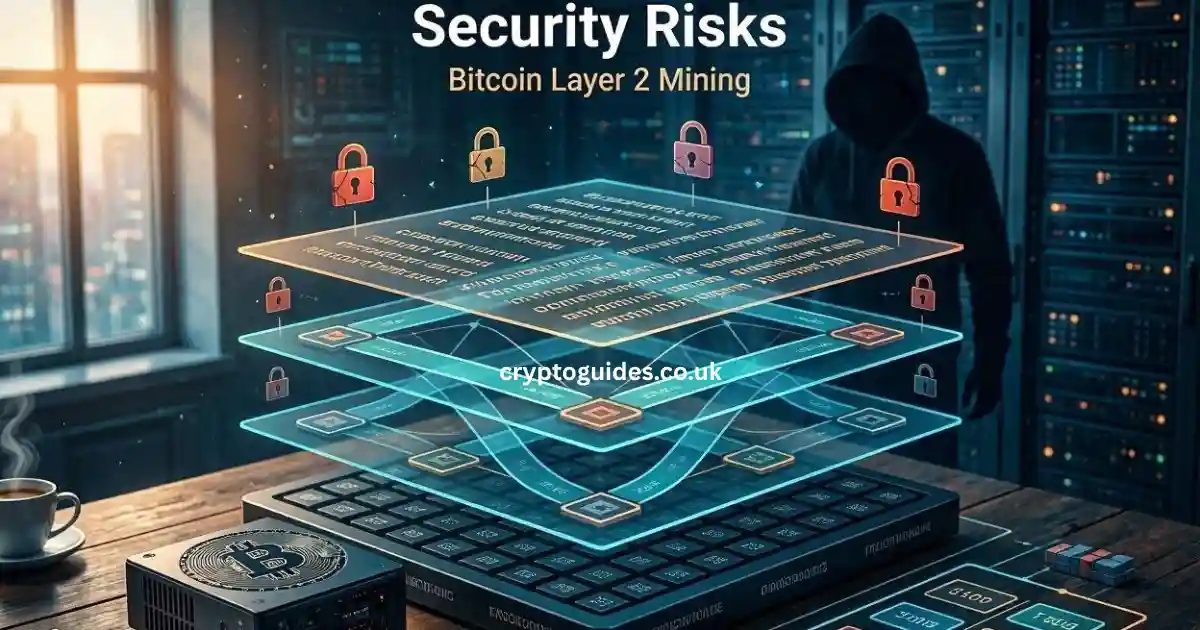
Security is a topic no serious Bitcoin Layer 2 blockchain mining guide can skip. The most significant risk is the hot wallet vulnerability. Unlike cold storage solutions where your Bitcoin sits completely offline, a Lightning Network node requires Bitcoin to be kept in an online wallet to function. This exposes it to potential hacking risks if your node device is compromised. Keeping only as much Bitcoin in your Lightning wallet as you need for active channels — and storing the rest in cold storage — is the smartest approach to managing this risk.
Channel breach attacks represent a more technical but equally real threat. A malicious channel partner could attempt to close a channel using an outdated state — essentially trying to steal funds by broadcasting an old balance to the Bitcoin blockchain. The Lightning Network defends against this through penalty transactions, but only if your node is online to catch it. This is where watchtower services become essential — they monitor your channels on your behalf even when your node is temporarily offline, protecting your Bitcoin Layer 2 blockchain mining funds around the clock.
How to Stay Safe While Doing Bitcoin Layer 2 Blockchain Mining
Bitcoin blockchain security in a Layer 2 context requires a layered approach — no pun intended. Here’s a complete security checklist every Bitcoin Layer 2 blockchain mining operator should follow:
| Security Measure | Why It Matters | Priority Level |
|---|---|---|
| Use a hardware wallet for large reserves | Keeps most funds offline and safe | Critical |
| Enable watchtower services | Protects channels when node is offline | Critical |
| Keep all software updated | Patches known vulnerabilities | High |
| Use strong unique passwords | Prevents unauthorised access | High |
| Enable Tor routing | Protects your node’s IP address | Medium |
| Regular backup of channel state | Recovers funds if node fails | Critical |
| Avoid third-party plugins | Reduces attack surface | Medium |
14. How Layer 2 Improves Bitcoin Scalability
Bitcoin network scalability is the most debated topic in the entire crypto world. The original Bitcoin design, while brilliant in its security and decentralisation, was never built to handle global-scale transaction volumes. At just 7 transactions per second, the Bitcoin blockchain technology would buckle under the weight of even a mid-sized country’s daily payment needs. This is the scalability problem that Bitcoin Layer 2 blockchain mining infrastructure directly addresses.
Layer 2 blockchain solutions improve Bitcoin scalability by moving the majority of transaction activity off the main chain entirely. The Lightning Network alone can theoretically handle millions of transactions per second — a figure that comfortably rivals and exceeds any traditional payment network. Critically, this doesn’t compromise the Bitcoin consensus mechanism or Bitcoin blockchain security in any way. The final settlement always happens on Layer 1, which means Bitcoin’s legendary security remains completely intact. Layer 2 simply adds a fast, cheap expressway on top of an already impenetrable foundation.
Why Scalability Makes Bitcoin Layer 2 Blockchain Mining the Future
Here’s the bigger picture that serious Bitcoin Layer 2 blockchain mining operators understand: scalability isn’t just a technical feature — it’s an economic multiplier. As Bitcoin becomes more scalable through Layer 2 adoption, more people use it. More usage means more transactions flowing through the network. More transactions means more routing fees for Lightning Network node operators. In other words, every improvement in Bitcoin network scalability directly benefits the income potential of everyone involved in Bitcoin Layer 2 blockchain mining. The two are inseparably linked and growing together.
15. Future of Bitcoin Layer 2 Blockchain Mining
The future of Bitcoin Layer 2 blockchain mining looks genuinely exciting. Several major technological upgrades are reshaping the landscape. Taproot — Bitcoin’s landmark 2021 upgrade — improved privacy and efficiency for Layer 2 protocols by making complex transactions look identical to simple ones on the blockchain. Schnorr signatures, bundled with Taproot, allow multiple signatures to be combined into one, reducing transaction size and cost. These upgrades make Bitcoin Layer 2 blockchain mining more efficient and more private than ever before.
BitVM is perhaps the most exciting development on the horizon. It enables complex computation and smart contracts on Bitcoin without changing Bitcoin’s base layer at all — a breakthrough that could bring entire new categories of decentralised applications to the BTC ecosystem. As institutional interest in Bitcoin grows in both the UK and USA, demand for scalable Bitcoin Layer 2 solutions will only increase. The regulatory environment is also maturing — clearer frameworks from the FCA and US regulators will give miners more confidence and attract even more capital into the Bitcoin Layer 2 ecosystem.
Predictions for Bitcoin Layer 2 Blockchain Mining by 2030
Industry experts and blockchain analysts broadly agree on several key trajectories for Bitcoin Layer 2 blockchain mining heading toward 2030:
| Prediction | Expected Timeline | Confidence Level |
|---|---|---|
| Lightning Network reaches 1 million active nodes | 2026–2027 | High |
| Layer 2 handles 50%+ of all Bitcoin transactions | 2027–2028 | Medium–High |
| BitVM enables full DeFi on Bitcoin | 2026–2027 | Medium |
| UK and USA regulatory clarity on Layer 2 mining | 2026 | High |
| Average node earnings double current levels | 2027–2029 | Medium |
| Ark Protocol reaches mainstream adoption | 2027–2028 | Medium |
As Bitcoin transaction speed and Bitcoin transaction fees continue to improve through Layer 2 development, the case for Bitcoin Layer 2 blockchain mining as a serious income source only strengthens.
16. Frequently Asked Questions About Bitcoin Layer 2 Blockchain Mining
What is Bitcoin Layer 2 Blockchain Mining in simple terms?
It’s the process of running a node on a secondary network built on top of Bitcoin. Instead of mining blocks like traditional miners do, you earn fees by helping route Bitcoin transactions through the network quickly and cheaply.
Is Bitcoin Layer 2 Blockchain Mining legal in the UK and USA?
Yes. Running a Lightning Network node and earning routing fees is legal in both the UK and USA. However, your earnings are taxable. In the UK, HMRC treats crypto income as taxable. In the USA, the IRS does the same. Always keep records of your earnings and consult a tax professional familiar with crypto.
How much can I earn from Bitcoin Layer 2 Blockchain Mining?
Earnings vary widely. A beginner node with modest liquidity might earn a few thousand satoshis per month. A well-optimised professional node can earn hundreds of thousands of satoshis monthly. The more liquidity you deploy and the better your node is connected, the more you earn.
Do I need expensive hardware for Bitcoin Layer 2 Blockchain Mining?
Absolutely not. A Raspberry Pi 4 and a 2TB SSD — costing under £200 in the UK or $250 in the USA — is all the hardware you need to start. This is one of the most beginner-accessible forms of crypto mining available today.
What’s the difference between Layer 1 and Layer 2 Bitcoin Mining?
Layer 1 mining uses proof of work (PoW) to validate blocks and earn block rewards. It requires expensive ASIC hardware and massive electricity consumption. Layer 2 mining involves running a node that routes transactions off-chain and earns routing fees. It’s faster, cheaper and far more accessible.
Is Bitcoin Layer 2 Blockchain Mining safe for beginners?
Yes — with proper security practices. The key risks involve hot wallet exposure and channel management. Using watchtowers, keeping most funds in cold storage and staying online consistently addresses the major security concerns effectively.
Quick Answers for Beginners Starting Bitcoin Layer 2 Blockchain Mining
How long does it take to set up a Lightning node?
With a device like Umbrel, initial setup takes 2 to 4 hours. Syncing the full Bitcoin blockchain takes an additional 2 to 5 days depending on your internet speed.
Can I mine Bitcoin Layer 2 on a regular laptop?
Technically yes, but it’s not ideal. A dedicated always-on device like a Raspberry Pi or a used mini PC is far better because your node needs to stay online 24/7 to earn consistent routing fees.
Which country is better for Layer 2 mining — UK or USA?
Both are excellent. The USA has a larger BTC ecosystem and more liquidity in the Lightning Network. The UK benefits from strong financial infrastructure and a growing crypto community. Your earnings depend more on your node setup than your geography.
17. Best Practices for Successful Bitcoin Layer 2 Blockchain Mining
Maintaining adequate channel liquidity is the foundation of successful Bitcoin Layer 2 blockchain mining. Your channels need both inbound and outbound liquidity to route transactions effectively. Inbound liquidity — Bitcoin that other nodes have locked into channels pointing toward you — is actually harder to obtain than outbound liquidity and is critically important for receiving payments and earning fees. Services like Lightning Pool and Magma (by Amboss) allow you to buy inbound liquidity from other node operators, solving this challenge directly.
Connecting to high-traffic, reputable nodes is equally vital. The Lightning Network is a web of connections, and your node’s position in that web determines how much traffic flows through it. Connecting to well-established nodes with high uptime and large channel capacities puts your node in the heart of the routing action. Tools like lncli listchannels and Amboss node rankings help you identify the best peers for your Bitcoin Layer 2 blockchain mining operation. Diversify your connections — don’t put all your liquidity into a single channel with a single peer.
Daily Habits of Successful Bitcoin Layer 2 Blockchain Miners
The most profitable Bitcoin Layer 2 blockchain mining operators treat their nodes like a small business. Every morning, they check their node’s status using dashboards like Ride The Lightning (RTL) or ThunderHub. They review which channels are balanced and which need rebalancing. They check their routing fee earnings from the previous 24 hours and adjust their fee rates if needed. They monitor for any failed routing attempts — which signal that a channel needs more liquidity or better peer connections. This daily 15-minute check-in habit, maintained consistently over weeks and months, is what separates profitable node operators from frustrated beginners who give up too soon.
18. Final Thoughts on Bitcoin Layer 2 Blockchain Mining
Bitcoin Layer 2 blockchain mining represents one of the most genuinely exciting opportunities in the entire BTC ecosystem right now. It’s accessible, affordable, environmentally responsible and aligned with where Bitcoin is heading as a global financial technology. The days of needing a warehouse full of ASIC machines to participate meaningfully in the Bitcoin network are over for everyday people. With a few hundred pounds or dollars and a willingness to learn, anyone in the UK or USA can become a genuine participant in Bitcoin’s Layer 2 ecosystem and earn real Bitcoin in the process.
This guide has taken you through everything — from the basic definition of Bitcoin Layer 2 blockchain mining to hardware choices, earning potential, security practices and future predictions. The knowledge is here. The tools exist. The community is active and welcoming. The only missing piece is your decision to start. Bitcoin network scalability is improving every month. The Lightning Network is growing every week. And every day you wait is a day someone else is earning routing fees that could have been yours.
Your Next Step Into Bitcoin Layer 2 Blockchain Mining Starts Now
Here’s your action plan — simple, direct and achievable this weekend. First, order your Raspberry Pi 4 and a 2TB SSD. Second, download Umbrel OS and set up your Bitcoin Core node. Third, install LND and create your Lightning wallet. Fourth, research high-traffic peers using Amboss and open your first channels. Fifth, monitor your node daily and optimise your fees as you learn what works. The Bitcoin Layer 2 blockchain mining journey starts with a single step — and that step is easier than you think.
“The best time to plant a tree was 20 years ago. The second best time is today.” — This ancient wisdom applies perfectly to Bitcoin Layer 2 blockchain mining in 2026. The network is growing. The tools are ready. And the opportunity is real.
Conclusion
Bitcoin Layer 2 blockchain mining is not a passing trend — it’s a fundamental evolution of how the Bitcoin network operates and how everyday people can participate in it. From the Lightning Network’s rapid transaction routing to the groundbreaking potential of BitVM and Ark Protocol, the Bitcoin Layer 2 ecosystem is maturing into something extraordinary. The Bitcoin blockchain technology at its foundation remains the most secure and decentralised monetary network ever created. Layer 2 simply makes it faster, cheaper and accessible to everyone.
Whether you’re a curious beginner in Birmingham or a crypto enthusiast in Boston, the path into Bitcoin Layer 2 blockchain mining is clearer and more affordable than ever before. Start small, learn consistently, manage your channels smartly and let the Lightning Network do the heavy lifting. The future of Bitcoin scaling solutions is already here — and it’s waiting for you to plug in and get started.

I am an SEO and Guest Posting expert with 5+ years of professional experience in building high-authority backlinks, strategic outreach, and scalable SEO campaigns, especially in the Crypto and Blockchain industry. Passionate about helping brands achieve sustainable organic growth, I specialize in guest posting, white-hat authority link building, content outreach, and digital PR strategies that enhance online credibility and search engine performance. Over the years, I have collaborated with international clients and global brands, delivering result-driven SEO solutions and placements on high-authority, high-DR websites focused on increasing organic traffic, domain authority, and online visibility in competitive markets.