What is Agentic GDP in Crypto? The Future of AI-Driven Blockchain Economy
Agentic GDP in Crypto means the total economic value created by AI agents working inside blockchain networks. These agents buy, sell, and trade on their own without human help. They generate real wealth by running smart contracts and managing digital assets automatically.
A world where AI handles your crypto portfolio every second of the day. These agents never sleep, never panic, and never make emotional mistakes. This is not the future — it is already happening right now in crypto markets.
AI agents in crypto can execute trades, provide liquidity, and earn yields all at once. They work across many blockchains and protocols at incredible speed. Their combined output is growing fast and is starting to rival human-driven crypto activity.
What is Agentic GDP in Crypto? How Does it work
The world of crypto is changing faster than most people can keep up with. A new concept is taking centre stage — and it’s one that could completely reshape how we measure economic activity in the digital world. That concept is Agentic GDP in Crypto. It sounds complex at first but once you break it down, it makes a lot of sense. And more importantly, it matters — a lot — for anyone investing in, building on, or simply curious about the future of blockchain technology.
Think about the traditional economy for a second. Governments measure economic output through GDP — Gross Domestic Product. It tells you how much value a country creates over a set period. Now imagine that same idea, but applied to a digital world where AI agents in crypto do the work instead of humans. No sleep. No breaks. No emotional decisions. Just pure, relentless economic output running 24 hours a day, seven days a week. That’s the world Agentic GDP describes — and it’s not science fiction. It’s happening right now.
This article breaks everything down for you. Whether you’re a seasoned crypto investor in the UK or USA, a Web3 builder looking for the next big opportunity, or simply someone trying to make sense of where blockchain technology is heading — you’re in the right place. By the time you finish reading, you’ll have a clear, confident understanding of what Agentic GDP in Crypto really means, why it matters, and how it could define the next chapter of the digital economy.
Meaning of Agentic GDP in Simple Terms
Let’s start with the basics. To understand Agentic GDP in crypto, you need to unpack three words: Agentic, GDP, and Crypto. Each one carries weight, and together they point to something genuinely new in the world of finance and technology.
GDP — Gross Domestic Product — is a term economists use to measure the total value of goods and services produced within an economy. It’s the scorecard nations use to gauge their economic health. A rising GDP means growth. A falling GDP means trouble. It’s simple, powerful, and universally understood in traditional finance.
Now layer in the word Agentic. This comes from the idea of agency — the ability to act independently and make decisions. In the context of artificial intelligence, an agentic system is one that doesn’t just respond to commands. It thinks, plans, and acts on its own to achieve a goal. It doesn’t wait to be told what to do next. It figures that out itself.
Put those ideas together inside the crypto and blockchain space, and you get Agentic GDP — a measure of the total economic value generated by autonomous economic systems operating on blockchain networks. These aren’t humans clicking buttons. These are digital autonomous agents running smart contracts, managing liquidity, executing trades, and generating yield — all without a single human command in real time.
Here’s a simple analogy. Imagine you own a factory. Normally, you hire workers, pay wages, manage shifts, and oversee production. Now imagine that factory runs itself. The machines order their own raw materials, adjust production lines based on demand, sell the finished goods, and deposit profits into your account — all while you sleep. That factory is generating real economic value without direct human involvement. Agentic GDP in crypto is essentially measuring the output of millions of such factories running simultaneously across blockchain networks worldwide.
Key Characteristics of Agentic GDP in Crypto:
| Characteristic | Description |
|---|---|
| Autonomous Operation | AI agents act without human instruction in real time |
| On-Chain Transparency | All activity is recorded and verifiable on the blockchain |
| 24/7 Continuous Output | Economic value is generated around the clock, every day |
| Borderless by Nature | Operates globally with no geographic restrictions |
| Programmable & Scalable | Rules are set in smart contracts and scale automatically |
This is a fundamentally different kind of economic measurement. Traditional GDP counts what humans produce. Agentic GDP in crypto counts what machines produce — on-chain, autonomously, and at a speed no human workforce could ever match.
How AI Agents Work in Blockchain Ecosystems

To really grasp the power behind Agentic GDP in crypto, you need to understand how AI agents in crypto actually function inside a blockchain ecosystem. This isn’t about robots with human faces. It’s about software systems with decision-making capabilities baked into their code — systems that read data, assess conditions, and take action based on pre-set or self-learned rules.
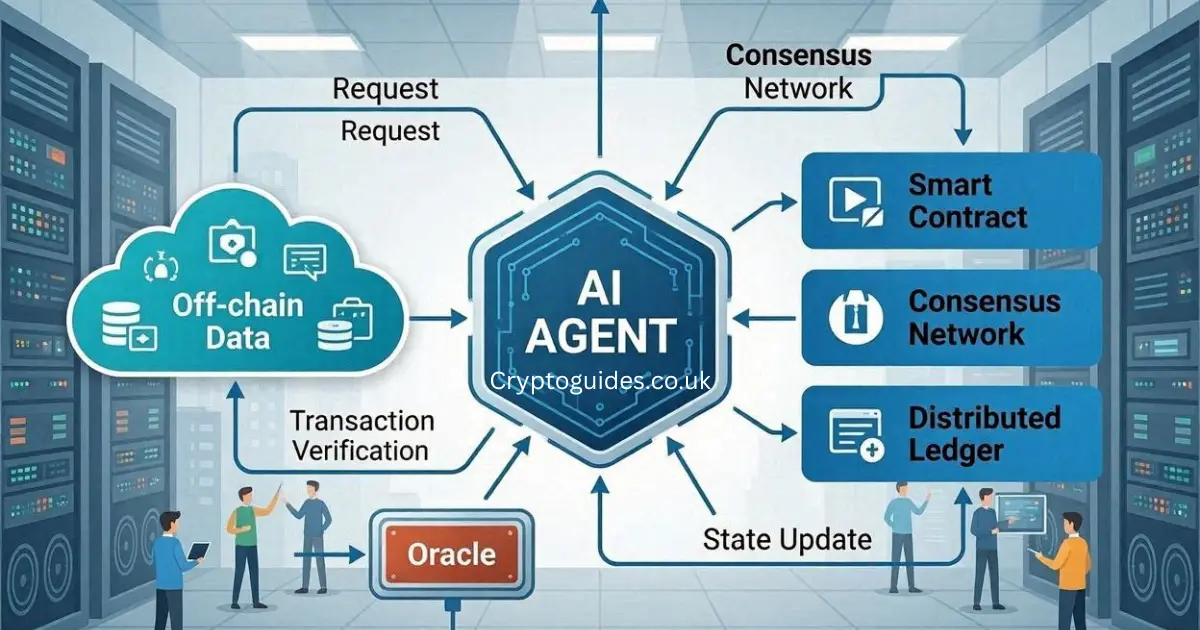
At their core, cognitive AI agents in blockchain operate through a layered technology stack. At the base, you have the blockchain itself — an immutable, transparent ledger where all transactions are recorded. On top of that sit smart contract automation systems — self-executing contracts that carry out agreed-upon actions when specific conditions are met. Then come the AI agents themselves, powered by machine learning in blockchain and large language models, capable of reading on-chain data and making intelligent decisions in milliseconds.
Oracles play a critical supporting role here. These are tools that feed real-world data — like asset prices, weather conditions, or sports results — into the blockchain so that agents can respond to external events. Without oracles, agents would be blind to the world outside the chain. With them, they become remarkably powerful decision-makers capable of acting on real-time market intelligence.
AI-powered blockchain networks also rely heavily on multi-agent systems — environments where multiple AI agents interact, negotiate, and sometimes compete with each other to achieve outcomes. In DeFi, for example, one agent might be looking for the best yield while another is hunting for arbitrage opportunities. These agents interact constantly, creating a dynamic, self-regulating economic environment that mirrors — and in many ways surpasses — the complexity of traditional financial markets.
Types of AI Agents Driving Agentic GDP in Crypto
Not all decentralized AI agents are built the same. They come in different forms, each designed to serve a specific economic function within the Web3 AI economy.
Trading and Arbitrage Agents are perhaps the most well-known. These are crypto trading bots AI systems that monitor price differences across exchanges and execute trades to capture profit — often in fractions of a second. They contribute enormously to crypto market automation and account for a large slice of on-chain trading volume across major decentralised exchanges.
Yield Optimisation Agents constantly scan DeFi protocols to find the highest possible returns on deposited capital. They move funds automatically between lending platforms, liquidity pools, and staking contracts — all in pursuit of maximum yield. Tools like Yearn Finance pioneered this concept, and it has since evolved into one of the most sophisticated arms of the decentralized finance (DeFi) AI ecosystem.
Liquidity Management Agents maintain the health of decentralised markets by supplying and rebalancing liquidity across trading pairs. Without them, many DeFi protocols would suffer from wild price swings and poor trade execution. They are a foundational pillar of crypto liquidity automation and directly support the stability of the broader digital asset economy.
Governance Agents participate in on-chain decision-making on behalf of token holders. They analyse proposals, cast votes, and manage treasury assets — all based on pre-programmed mandates. These are especially relevant in decentralized autonomous organizations (DAO) where governance is fully on-chain.
Cross-Chain Bridge Agents operate across multiple blockchain networks, moving assets between chains, bridging liquidity, and enabling the AI-native blockchain ecosystems of tomorrow to communicate and collaborate seamlessly.
Why Agentic GDP is Important for the Crypto Economy
Here’s where things get genuinely exciting. Agentic GDP in crypto isn’t just a new buzzword for analysts to argue about. It represents a fundamental shift in how economic value is created, measured, and distributed in the digital world. Understanding why it matters puts you ahead of the curve — and in crypto, being ahead of the curve is everything.
For starters, Agentic GDP in crypto gives us a new lens through which to measure the health and growth of blockchain-based economic models. Traditional metrics like trading volume, total value locked (TVL), or market capitalisation only tell part of the story. They don’t capture the economic output generated autonomously by AI decision-making systems operating within these networks. Agentic GDP attempts to fill that gap — providing a more complete, honest picture of what’s really happening inside the blockchain economy.
Consider this: according to data from Dune Analytics and various DeFi research teams, automated bots and agents account for anywhere between 40% and 80% of total transaction volume on major decentralised exchanges like Uniswap. That’s not noise — that’s the majority of economic activity on some of the most important financial infrastructure in Web3. If you’re not measuring autonomous AI systems contribution to output, you’re missing most of the picture.
Crypto economic growth increasingly depends on the efficiency and intelligence of these systems. As AI-driven automation improves, agents get smarter, faster, and more capital-efficient. This drives down costs, improves market liquidity, and creates new economic opportunities that wouldn’t exist in a purely human-driven market. The multiplier effect is enormous — and it’s only accelerating.
There’s also a policy dimension that UK and USA investors should pay close attention to. Just as traditional GDP shaped how governments designed fiscal and monetary policy, Agentic GDP in crypto could become a benchmark for how regulators, DAOs, and protocol developers make decisions about network upgrades, token issuance, and economic incentives. It’s a governance tool as much as it is a measurement tool. And in a space where data drives decisions, having the right metric matters immensely.
Difference Between Traditional GDP and Agentic GDP
Most people grew up hearing about GDP in economics class. It’s one of the most trusted measurements in global finance. But Agentic GDP in crypto works very differently — and understanding those differences is key to grasping why this new concept is so significant for the future of the digital autonomous agents economy.
Traditional GDP measures the monetary value of all goods and services produced within a country’s borders during a specific time period — usually a quarter or a year. It covers everything from factory output and retail sales to government spending and net exports. The data comes from surveys, tax records, employment figures, and other lagging indicators. It’s slow, it’s backward-looking, and it requires enormous administrative infrastructure to compile accurately.
Agentic GDP in crypto, on the other hand, operates in real time. Because all activity happens on a public blockchain, every transaction an agent executes is instantly recorded, timestamped, and verifiable. There’s no waiting for quarterly reports. There are no surveys to send out. The data is simply there — transparent, immutable, and accessible to anyone with an internet connection. This makes on-chain intelligence systems capable of producing economic measurements that are faster, more granular, and arguably more accurate than anything traditional economics can offer.
| Factor | Traditional GDP | Agentic GDP in Crypto |
|---|---|---|
| Generated By | Human workers and businesses | AI agents in crypto and autonomous systems |
| Measurement Speed | Quarterly or annual reports | Real-time, 24/7 on-chain data |
| Geographic Boundary | National borders | Global, borderless, permissionless |
| Oversight Mechanism | Government agencies | Smart contract automation |
| Transparency | Limited, requires audits | Fully public and verifiable on-chain |
| Inclusivity | Requires citizenship or legal status | Open to any wallet address globally |
| Error Rate | Subject to human reporting errors | Mathematically precise by design |
Another critical difference lies in who — or rather what — does the work. Traditional GDP is fundamentally a human metric. It measures human labour, human creativity, and human enterprise. Agentic GDP in crypto measures the output of an autonomous digital workforce — software systems that don’t need salaries, don’t take sick days, and don’t make emotionally driven mistakes.
This doesn’t mean Agentic GDP is better in every way. Traditional GDP captures qualitative dimensions of human economic life — wellbeing, employment, social progress — that a purely transactional on-chain metric might miss. But for measuring the mechanical output of a machine-driven economy running on blockchain rails, Agentic GDP is simply a superior tool. And as the Web3 economic evolution continues, its importance will only grow.
Role of Autonomous AI Agents in Crypto Trading
If you’ve spent any time watching crypto markets, you’ve probably noticed something strange. Prices move at lightning speed. Arbitrage windows open and close in milliseconds. Liquidity appears and disappears in seconds. Humans can’t do that. But autonomous AI systems can — and they do, constantly, across every major blockchain network on the planet.
Crypto trading bots AI systems have been a part of crypto markets almost since the beginning. Early versions were simple — basic algorithms set to buy low and sell high based on preset price triggers. But today’s agents are a completely different beast. Powered by self-learning algorithms and generative AI agents, modern trading agents analyse order books, social sentiment, on-chain data flows, and macroeconomic signals all at once — then act on that analysis in real time.
One of the most fascinating — and controversial — areas of AI-driven automation in crypto trading is MEV — Maximal Extractable Value. MEV bots scan the blockchain’s transaction queue (called the mempool) and look for profitable opportunities to reorder, insert, or censor transactions before they’re confirmed. This practice, while legally grey in many jurisdictions, generates billions in value annually and represents one of the purest expressions of agent-based economy mechanics in crypto today.
“MEV is the dark forest of crypto — brutal, competitive, and governed entirely by code. It’s the perfect example of autonomous economic agents creating and capturing value at machine speed.” — A commonly cited description among Ethereum developers and researchers
Arbitrage agents operate across decentralised exchanges — platforms like Uniswap, Curve, and Balancer — seeking price discrepancies between trading pairs. When ETH is priced at $3,000 on one exchange and $3,005 on another, an arbitrage bot closes that gap in milliseconds, pocketing the difference. Multiply that across thousands of trades per minute, and you get a significant contributor to Agentic GDP in crypto.
What’s particularly significant for the broader crypto market automation landscape is how these agents don’t just extract value — they create it. By narrowing price spreads and improving market efficiency, trading agents make crypto markets more reliable and accessible for everyone, including regular retail investors in the UK and USA who simply want to buy and hold digital assets.
How Agentic AI is Creating New Digital Economies
Here’s a thought that should stop you in your tracks. What happens when AI agents don’t just trade with humans — but start trading with each other? What happens when entire economic ecosystems emerge where the buyers, sellers, service providers, and consumers are all autonomous software agents? That future isn’t decades away. It’s already taking shape, and it’s one of the most profound developments in the history of Web3 financial systems.
Agent-based economy structures are beginning to emerge across the crypto landscape. In these ecosystems, digital autonomous agents operate as independent economic units. They earn income, pay for services, negotiate contracts, and accumulate assets — all without human oversight. Think of it as a new layer of the internet economy, running underneath the human layer, operating at machine speed and at a scale that would be impossible for any human workforce to replicate.
Projects like Fetch.ai have been pioneering this vision for years. Their platform enables autonomous economic systems where agents can discover each other, negotiate terms, and transact autonomously — creating what they call an “Internet of Agents.” Similarly, Autonolas (also known as Olas) provides infrastructure for building decentralised, composable multi-agent systems that can coordinate complex economic tasks across multiple blockchain networks simultaneously.
This emergence of AI-native blockchain ecosystems is giving birth to something economists are only beginning to theorise about — a tokenized AI economy where value flows not from human labour but from algorithmic intelligence. In this new paradigm, the builders who create the best agents, the most efficient protocols, and the smartest AI infrastructure for Web3 will capture enormous economic rewards. It’s a land grab — but for code, not territory.
The macroeconomic implications are staggering. When autonomous AI systems can create, sustain, and grow entire economies without human intervention, the very definition of “economic activity” has to evolve. Agentic GDP in crypto is the first serious attempt to measure this new form of value creation — and its growth trajectory suggests this is no passing trend.
Examples of Agentic Systems in Web3 and Crypto
Theory is great. But real-world examples make everything click. Several projects are already building and scaling Agentic GDP in crypto right now — and their growth tells you everything you need to know about where the Web3 AI economy is heading.
Fetch.ai (FET) is one of the original pioneers. Founded in 2017 and based in Cambridge, UK, Fetch.ai builds a decentralised network where cognitive AI agents can perform tasks autonomously — from optimising travel bookings to managing DeFi positions. Their agents communicate using a shared language protocol and transact in FET tokens, creating a living, breathing agent-based economy on-chain. Fetch.ai merged with SingularityNET and Ocean Protocol in 2024 to form the Artificial Superintelligence Alliance (ASI) — one of the most significant mergers in the artificial intelligence economy space.
Autonolas (OLAS) offers a framework for building decentralized AI agents that can be composed together like building blocks. Their technology underpins several real applications including automated market intelligence tools, decentralised keeper networks, and cross-chain coordination services. Autonolas represents a genuine infrastructure layer for the Agentic GDP ecosystem.
Virtuals Protocol operates on the Base blockchain and functions as a launchpad for tokenised AI agents. Users can deploy, own, and monetise AI agents — effectively turning intelligent software into economic assets. Each agent generates value through its actions and shares revenue with its token holders. This is the programmable money systems concept made real.
Bittensor (TAO) takes a different but equally fascinating angle. It creates a decentralised network for machine learning models, where AI systems compete to produce the most valuable intelligence outputs. Contributors earn TAO tokens based on the usefulness of their AI contributions — making it a true token economy model for artificial intelligence.
Morpheus AI is an open-source project building a marketplace for generative AI agents that operate across Web3 applications. Its vision is a decentralised ecosystem where anyone can build, deploy, and monetise smart agents — contributing to a genuinely decentralized autonomous AI economy.
| Project | Blockchain | Core Function | Native Token |
|---|---|---|---|
| Fetch.ai (ASI Alliance) | Ethereum/Cosmos | Autonomous economic agents | FET/ASI |
| Autonolas | Multi-chain | Agent infrastructure & frameworks | OLAS |
| Virtuals Protocol | Base | AI agent launchpad & monetisation | VIRTUAL |
| Bittensor | Independent | Decentralised AI/ML marketplace | TAO |
| Morpheus AI | Ethereum/Arbitrum | Open-source AI agent marketplace | MOR |
These projects aren’t just experiments. They’re building the AI infrastructure for Web3 that will power the next generation of blockchain AI integration — and together, they represent the living, breathing infrastructure of Agentic GDP in action.
Impact of Agentic GDP on DeFi (Decentralized Finance)
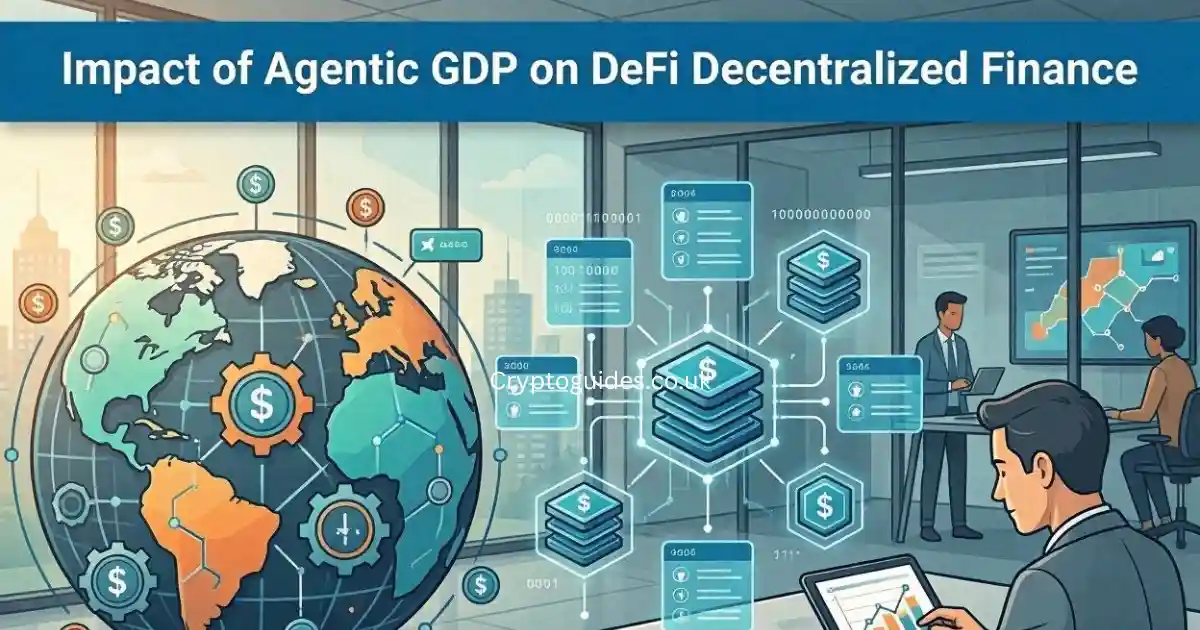
If there’s one corner of the crypto world where Agentic GDP in crypto hits hardest and fastest, it’s decentralized finance (DeFi) AI. DeFi — the ecosystem of financial services running on blockchain networks without banks or intermediaries — was practically built for autonomous agents. And the numbers prove it.
At its peak in 2021, DeFi locked over $180 billion in total value across protocols like Aave, Compound, Uniswap, and Curve. But managing that capital efficiently — finding the best yields, rebalancing positions, avoiding liquidations, and optimising gas costs — was far beyond what human users could do manually. AI-powered blockchain networks stepped in to fill that gap, and the DeFi ecosystem has never looked back.
Crypto liquidity automation is perhaps the most visible impact of Agentic GDP on DeFi. Liquidity providers used to manually move funds between pools, chasing yield while trying to minimise impermanent loss. Today, autonomous yield agents do that work continuously and intelligently. Protocols like Yearn Finance popularised this with their vaults — automated strategies that compound returns and shift capital between protocols based on live data. These vaults manage hundreds of millions in assets with zero human intervention day-to-day.
Lending and borrowing agents have also transformed Web3 financial systems. On platforms like Aave, autonomous agents monitor collateralisation ratios in real time. When a position approaches the liquidation threshold, an agent executes the liquidation automatically — protecting the protocol from bad debt and ensuring the system remains solvent. This role — once performed manually by human liquidators watching dashboards around the clock — is now entirely handled by autonomous economic systems.
Smart contract automation in DeFi also enables entirely new financial products that couldn’t exist without agents. Flash loans — loans that are borrowed and repaid within a single transaction block — are one powerful example. Only a machine can borrow, deploy, and repay a loan in the time it takes to process one blockchain block. Flash loans enable capital-efficient arbitrage, collateral swaps, and self-liquidation strategies that are simply impossible in traditional finance.
“DeFi without AI agents is like a stock market without electronic trading — functional but painfully slow and inefficient. Agents are what make DeFi truly powerful.” — A perspective widely shared among DeFi developers and researchers
The impact on crypto economic growth is measurable. Research from Chainalysis and Messari consistently shows that protocol-level automation — driven by machine learning in blockchain and autonomous agent logic — is a primary driver of TVL growth, fee revenue, and user adoption across DeFi. As agents grow smarter and more interconnected, their contribution to Agentic GDP will only deepen.
Can Agentic AI Replace Human Economic Activity?
This is the question everyone’s thinking but not everyone’s asking out loud. Can autonomous AI systems eventually replace human economic activity altogether? It’s a fair question — and it deserves a direct, honest answer rather than corporate-speak reassurances.
The short answer is: not entirely. But the more nuanced answer is: in many specific functions, they already have — and that replacement will continue to deepen. The real question isn’t whether agents will replace humans in certain roles. They already have. The real question is what new roles humans will take on as a result — and whether those new roles are better or worse than the ones being automated away.
In crypto market automation, machines already outperform humans in almost every measurable way when it comes to execution. Speed, consistency, emotional neutrality, and the ability to process vast datasets simultaneously — these are areas where AI decision-making systems have no human competition. A skilled human trader might make 50 good decisions a day. An autonomous agent might make 50,000 decisions per minute, each grounded in real-time data and zero emotional bias.
However, humans still hold significant advantages in areas that require creativity, moral judgment, strategic vision, and the ability to navigate genuinely novel situations. Designing new financial protocols, identifying emerging market narratives, building community trust, and making ethical decisions about how economic systems should work — these remain deeply human endeavours. Generative AI agents can assist with these tasks but cannot replace the human intelligence that drives them.
Think of it this way. When ATMs were introduced, people predicted bank tellers would disappear entirely. Instead, teller jobs evolved. Banks opened more branches, tellers took on more complex customer service roles, and the financial industry grew overall. Agentic AI in crypto is likely to follow a similar trajectory — not eliminating human participation but radically reshaping what that participation looks like. The most successful investors and builders won’t be those who fight against the rise of autonomous digital workforce systems. They’ll be those who learn to direct, design, and benefit from them.
For UK and USA investors, this means one thing above all: understanding Agentic GDP in crypto isn’t optional. It’s essential. The investors who grasp this concept earliest will be positioned to benefit most from the economic systems it creates.
Benefits of Agentic GDP in Blockchain Networks
The case for Agentic GDP in crypto isn’t built on hype alone. There are concrete, measurable benefits that autonomous economic systems bring to blockchain networks — and understanding them helps you see why this concept is attracting serious attention from developers, investors, and institutions worldwide.
Around-the-clock economic output is perhaps the most straightforward benefit. Traditional financial markets have opening and closing hours. Stock exchanges go dark on weekends and public holidays. AI-powered blockchain networks, by contrast, operate continuously. In the UK, while the London Stock Exchange closes at 4:30 PM, DeFi protocols powered by autonomous AI systems are executing thousands of transactions per second at midnight on Christmas Day. This continuous operation means the digital asset economy never stagnates — value is always being created, moved, and compounded.
Dramatically reduced operational costs represent another major advantage. When smart contract automation handles tasks that would otherwise require teams of analysts, traders, and compliance officers, the cost savings are substantial. These savings don’t just benefit protocol operators — they flow through to users in the form of lower fees, better yields, and more competitive financial products. The next-generation internet economy is fundamentally more cost-efficient than anything built on traditional financial infrastructure.
Greater market liquidity and stability emerge naturally from the presence of active, intelligent agents. Markets with deep liquidity are more stable, less manipulable, and more attractive to institutional participants. As crypto liquidity automation matures, the argument that crypto markets are too volatile and immature for serious institutional investment becomes harder and harder to sustain.
Accelerated innovation cycles represent perhaps the most exciting benefit for builders. When autonomous agents handle routine economic operations, human developers are freed to focus on higher-order challenges — designing better protocols, exploring new primitives, and building entirely new categories of financial applications. The Web3 economic evolution is accelerating precisely because automation is raising the ceiling of what small teams of developers can achieve.
New revenue streams and economic opportunities are also emerging directly from the growth of Agentic GDP in crypto. Developers who build successful agents can earn fees from their usage. Token holders in agent networks earn rewards from agent activity. Even passive investors can capture returns from the economic output of autonomous systems they help to fund. This creates a genuinely new economic model — one where capital can earn returns from machine intelligence rather than just human labour.
Risks and Challenges of Agentic AI in Crypto
No honest discussion of Agentic GDP in crypto is complete without addressing the risks. The technology is genuinely exciting — but it also introduces new categories of risk that anyone operating in this space needs to understand clearly. Being informed about the challenges isn’t pessimism. It’s just good investing.
Smart contract vulnerabilities are the most immediate technical risk. Autonomous agents are only as good as the code they run on. If a smart contract contains a bug or an exploitable logic flaw, a malicious actor — or even another rogue agent — can drain funds instantly. The 2022 Ronin Network hack ($625 million) and the Wormhole bridge exploit ($320 million) are sobering reminders of what’s at stake. As agents become more complex and interconnected, the attack surface grows wider and the potential damage from a single vulnerability grows larger.
Flash crash risk from agent coordination is a concern that’s starting to get serious attention from researchers. When many autonomous agents respond to the same market signal simultaneously, the result can be a cascade of automated actions that amplifies price movements rather than dampening them. In traditional finance, circuit breakers exist to halt trading during extreme volatility. In most DeFi environments, no such mechanism exists — which means coordinated agent behaviour could theoretically trigger market collapses of extraordinary speed and scale.
Regulatory uncertainty sits heavily over the entire blockchain AI integration space. In the USA, the SEC and CFTC are still debating jurisdiction over crypto assets. In the UK, the Financial Conduct Authority (FCA) has taken a cautious approach to crypto regulation. Neither framework was designed with autonomous economic systems in mind. As Agentic GDP grows, regulators will face difficult questions about accountability — particularly when an autonomous agent causes financial harm. Who is responsible? The developer? The token holder? The DAO? These questions don’t have clean answers yet.
Concentration of power is a subtler but equally important risk. If the most powerful and profitable agents are controlled by a small number of sophisticated players — large crypto funds, well-resourced developers, or institutional traders — the promised democratisation of the tokenized AI economy may never materialise. Instead of broadening access to financial opportunity, Agentic GDP could end up concentrating wealth even more dramatically than traditional finance already does.
Energy and infrastructure costs also deserve attention. Running complex multi-agent systems at scale consumes significant computational resources. As agent sophistication grows, so does the demand for powerful infrastructure — raising environmental and cost concerns that the industry will need to address proactively.
Being aware of these risks doesn’t mean stepping back from the opportunity. It means stepping into it with your eyes open — which is always the smarter position.
Future of Agentic GDP in the Crypto Industry
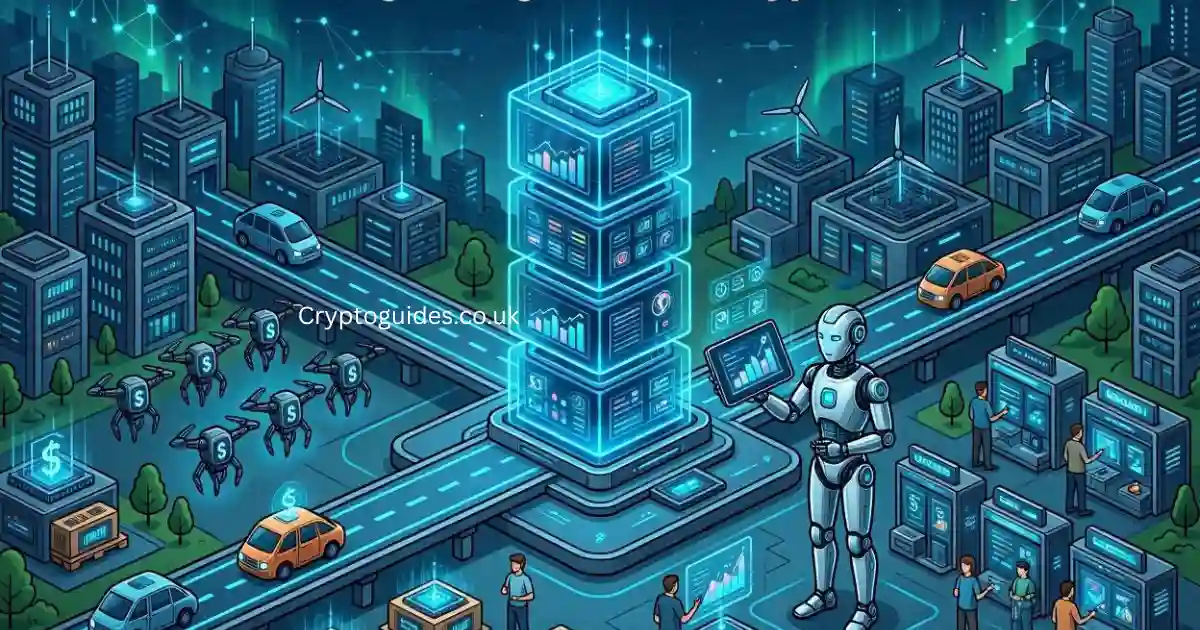
The trajectory of Agentic GDP in crypto over the next five years is one of the most compelling investment narratives in the entire digital asset space. The foundations are already laid. The infrastructure is being built. And the economic logic is irresistible for anyone looking at the data with clear eyes.
Over the near term — the next 12 to 24 months — expect rapid expansion in the number and sophistication of decentralized AI agents operating across major blockchain networks. Ethereum, Solana, Base, and Cosmos-based chains are all attracting agent developers at an accelerating pace. The competition to build the most capable, most profitable, and most secure agents will intensify — driving innovation at a pace that traditional finance simply cannot match.
In the medium term — two to five years out — the emergence of truly AI-native blockchain ecosystems seems highly probable. These will be chains and protocols designed from the ground up to serve autonomous digital workforce systems rather than human users. Gas fee structures, transaction ordering, data availability — all of these technical parameters will be optimised for agent performance rather than human usability. The future of digital economy infrastructure will look very different from what we use today.
The longer-term vision is even more transformative. Researchers and futurists increasingly describe a world where autonomous economic systems manage significant portions of global capital — not just in crypto but potentially bridging into traditional finance through tokenized assets, programmable CBDCs (Central Bank Digital Currencies), and on-chain derivatives markets. In this world, Agentic GDP becomes not just a crypto metric but a global economic benchmark.
“The convergence of AI and blockchain is the defining technology story of the next decade. Agentic GDP is the economic theory that will explain what that convergence produces.” — A perspective gaining traction among researchers at the intersection of AI and Web3
For UK and USA investors specifically, the window of opportunity is open right now. Early movers in the agent-based economy — those who understand the infrastructure, back the right projects, and build positioning before institutional capital floods in — will likely look back on this period the way early DeFi participants look back on 2020. It won’t feel like genius in the moment. But in hindsight, the signals were always there.
Is Agentic GDP the Next Big Narrative in Web3?
Crypto has always run on narratives. ICOs. DeFi Summer. NFT mania. The L2 explosion. Each narrative brought a wave of capital, attention, and innovation — and each one left behind a changed landscape. Agentic GDP in crypto is shaping up to be the next major narrative — and there are strong reasons to believe it has more substance and staying power than any that came before it.
Unlike NFT speculation, which was largely driven by cultural trends and social dynamics, Agentic GDP is grounded in fundamental technological progress. Artificial intelligence economy concepts don’t rely on hype cycles to sustain them. They rely on real utility — faster markets, more efficient capital allocation, lower costs, and greater economic output. That’s a much sturdier foundation for a long-term narrative.
Unlike DeFi Summer — which was extraordinary but also dependent on unsustainable yield incentives — the growth of autonomous AI systems in crypto is driven by genuine productivity gains. Agents that make markets more efficient, manage capital more intelligently, and create new economic primitives are generating real value. That value doesn’t evaporate when the incentive programme ends.
The data supports this reading. Venture capital investment into AI infrastructure for Web3 projects surged through 2024 and 2025, with firms like Andreessen Horowitz, Paradigm, and Multicoin Capital all making significant bets on the agent-based economy thesis. Token prices for leading AI-crypto projects significantly outperformed the broader market during this period — a classic signal that a new narrative is taking hold among sophisticated investors.
On social platforms like X (formerly Twitter), in crypto research newsletters, and on podcasts like Bankless, Unchained, and The Defiant, Agentic GDP and related concepts are appearing with increasing frequency. The conversation is moving from niche developer circles into mainstream crypto investing discourse. For contrarian investors in the UK and USA, that trajectory should be very familiar — and very promising.
If you missed DeFi Summer in 2020, missed the NFT wave in 2021, or missed the L2 narrative in 2023 — this might be the moment you’ve been waiting for. Agentic GDP in crypto is still early enough that informed positioning is possible but mature enough that the fundamentals are real and verifiable.
Conclusion: What Agentic GDP Means for Investors and Builders
Let’s bring everything together. Agentic GDP in crypto is not a concept you can afford to dismiss as jargon or speculation. It describes something genuinely real — the measurable economic output generated by autonomous AI systems operating on blockchain networks, creating value continuously, efficiently, and at a scale that human economic activity simply cannot match.
Here are three things every investor and builder should take away from this article:
First, Agentic GDP in crypto is already here. The AI agents in crypto driving trading, liquidity management, yield optimisation, and on-chain governance are not theoretical. They exist today, they are generating billions in economic value, and their contribution to the digital asset economy is growing every month. This is not a concept for the distant future — it is the present reality of Web3.
Second, the infrastructure layer of this new economy is still being built — and that’s where the opportunity lives. Projects building AI infrastructure for Web3, designing multi-agent systems, and creating the protocols that enable autonomous economic systems to operate safely and efficiently are positioning themselves at the foundation of a potentially enormous new economic layer. For investors with the right risk tolerance and research capabilities, this space warrants serious attention.
Third, understanding Agentic GDP is as important for builders as it is for investors. If you’re developing in Web3 today, the agents you build, the protocols you design, and the economic systems you create will increasingly be judged by their contribution to on-chain, machine-driven economic output. Agentic GDP is becoming the metric by which the Web3 economic evolution will be measured — and the builders who internalize that concept earliest will have a meaningful advantage.
The rise of the machine-driven economy on blockchain is not something happening to the crypto industry. It’s something the crypto industry is making happen — faster and more ambitiously than almost anyone in traditional finance has yet recognised. The question isn’t whether Agentic GDP in crypto will matter. It already does. The only question is whether you’ll be positioned to benefit from it.
This article is intended for educational and informational purposes only and does not constitute financial or investment advice. Always conduct your own research before making investment decisions.

I am an SEO and Guest Posting expert with 5+ years of professional experience in building high-authority backlinks, strategic outreach, and scalable SEO campaigns, especially in the Crypto and Blockchain industry. Passionate about helping brands achieve sustainable organic growth, I specialize in guest posting, white-hat authority link building, content outreach, and digital PR strategies that enhance online credibility and search engine performance. Over the years, I have collaborated with international clients and global brands, delivering result-driven SEO solutions and placements on high-authority, high-DR websites focused on increasing organic traffic, domain authority, and online visibility in competitive markets.