What is Cryptocurrency for Beginners (2026 Guide)
This guide is designed to be your ultimate roadmap. We will explain exactly what is cryptocurrency for beginners (2026 guide) in plain English, helping you understand how to navigate this exciting market with confidence. Whether you are looking to grow your wealth or simply stay ahead of the curve, this is the most important financial lesson of the decade.
The world of finance is moving faster than ever. If you have been hearing about digital assets, blockchain, and Web3 but felt overwhelmed, you are not alone. In 2026, cryptocurrency has moved from a niche tech experiment to a global financial powerhouse.
What is Cryptocurrency?
Cryptocurrency is a digital-only form of money that uses cryptography for security. Unlike the dollar or the pound, it is decentralized, meaning no single bank or government controls it. It exists on a distributed ledger called a blockchain, which acts as a transparent, unchangeable record of every transaction ever made.
1. How Blockchain Technology Powers Your Money

To understand crypto, you must understand the blockchain. Think of it as a public digital notebook. When you send money to a friend, the network of computers (nodes) checks the “notebook” to ensure you have the funds. Once verified, the transaction is locked in a “block” and added to the “chain.”
Because this record is shared across thousands of computers, it is nearly impossible to hack. This peer-to-peer system ensures that you are always in total control of your digital wealth without needing a middleman.
The Role of Decentralization
In traditional banking, the bank acts as the “middleman” that verifies your balance. In the crypto world, the network itself performs this role. This peer-to-peer system removes the need for a central authority, which reduces fees and prevents any single entity from “freezing” your funds.
Cryptography and Security
The “crypto” in cryptocurrency refers to the advanced mathematical encryption used to protect your data. Every user has a public key (like an email address) and a private key (like a high-security password). Without the private key, no one—not even the network itself—can move your assets.
2. Why 2026 is the Best Time to Start
We have entered the era of Institutional Adoption. In 2026, major banks and retirement funds now offer crypto-backed assets. This means the market is more stable and regulated than ever before.
- Smart Contracts: These are digital agreements that execute automatically. They power everything from insurance to real estate.
- DeFi (Decentralized Finance): You can now earn “interest” on your crypto that often beats traditional savings accounts.
- Web3 Integration: The internet is becoming “ownable,” and cryptocurrency is the fuel for this new digital economy.
3. Meet the Big Players: Bitcoin, Ethereum, and Beyond
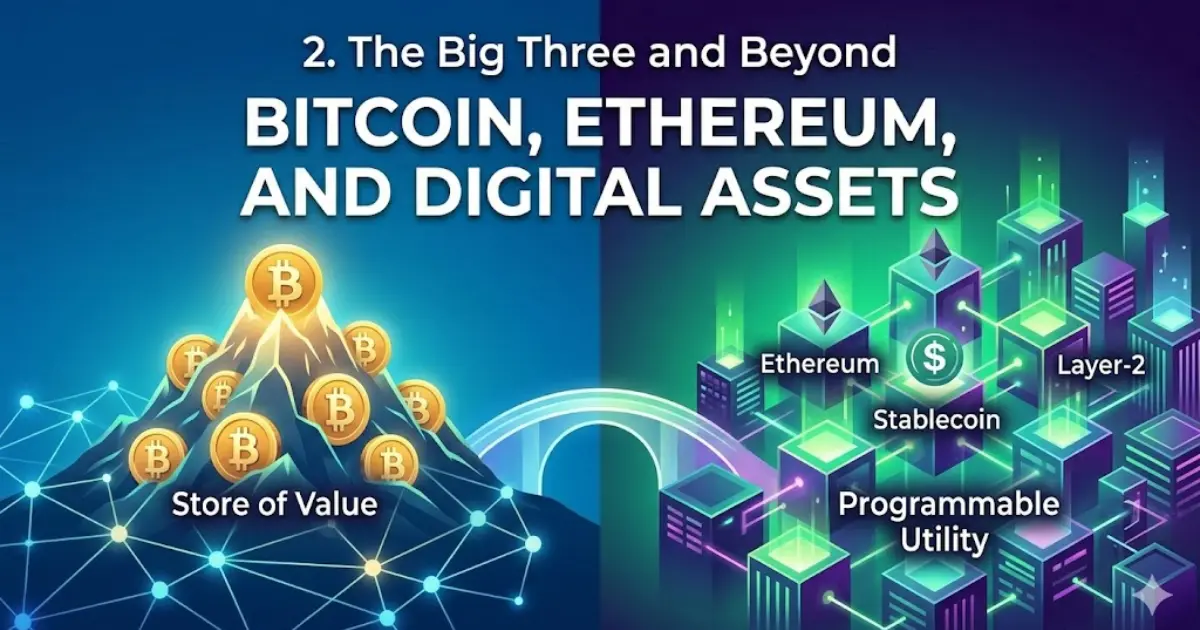
Not all coins do the same thing. Understanding the different digital assets is key to a smart strategy.
- Bitcoin (BTC): The original. It is viewed as “Digital Gold” because there will only ever be 21 million coins.
- Ethereum (ETH): More than just money; it is a giant global computer. It allows developers to build decentralized applications (dApps).
- Stablecoins (USDT/USDC): These are pegged 1:1 to the US Dollar. They offer the speed of crypto without the price volatility.
4. The Power of Layer-2 Solutions
In the past, crypto was slow and expensive. In 2026, Layer-2 scaling has fixed this. Networks like Polygon and Arbitrum sit on top of the main blockchain to make transactions instant and nearly free. This makes using crypto for everyday purchases, like coffee or online shopping, a reality for the first time.
5. Setting Up Your Secure Crypto Wallet
Safety is the #1 priority for beginners. To hold crypto, you need a digital wallet.
- Hot Wallets: Apps on your phone. Great for small amounts and daily use.
- Cold Wallets: Physical devices that stay offline. This is the best practice for long-term savings because they are immune to online hackers.
- Private Keys: This is your “master password.” In 2026, we always say: “Not your keys, not your coins.” Never share your seed phrase with anyone.
6. How to Buy Your First Cryptocurrency Coin Safely
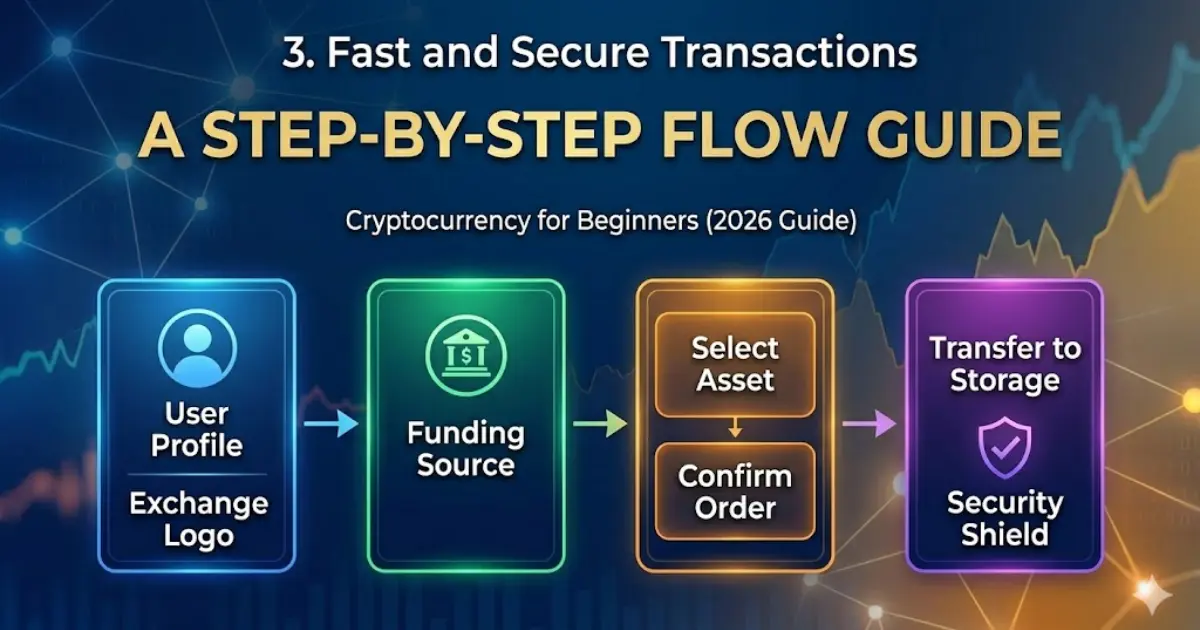
Buying crypto is now as easy as using a banking app.
- Choose an Exchange: Pick a platform with high trustworthiness and low fees.
- Verify Your Identity: This is called KYC (Know Your Customer) and it keeps the ecosystem safe from fraud.
- Deposit Funds: Use a bank transfer or card to buy your first fraction of a coin.
- Transfer to Storage: For maximum security, move your coins from the exchange to your own private wallet.
7. Understanding Market Volatility and Risk
While the rewards can be high, market volatility is real. Prices can go up and down quickly.
- Pro Tip: Never invest money you need for rent or bills.
- Strategy: Many professionals use Dollar Cost Averaging (DCA), which means buying a small amount every week regardless of the price. This lowers your risk over time.
8. Passive Income through Staking
In 2026, you don’t just hold crypto; you make it work for you. Proof of Stake (PoS) allows you to “lock” your coins to help secure the network. In return, you receive rewards in the form of more coins. It is like earning dividends on a stock, but in the decentralized economy.
9. Common Scams and How to Spot Them
The most important part of our What is Cryptocurrency for Beginners (2026 Guide) is keeping you safe.
- Phishing: Never click links in emails asking for your wallet details.
- Rug Pulls: Avoid “new” coins that promise 1000% returns overnight.
- Fake Support: Real crypto companies will never DM you on social media to “sync your wallet.”
10. The Future: Real-World Assets (RWA)
The biggest trend in 2026 is Tokenization. This means real-world things like gold, real estate, and even fine art are being put on the blockchain. This allows beginners to buy a “piece” of an expensive apartment for as little as $50. Cryptocurrency is democratizing wealth for everyone.
11. Tax and Legal Clarity in 2026
Governments in the USA and UK now have clear rules for crypto. Most consider it “property,” meaning you pay tax on the profit when you sell. Using automated tax tools makes this process simple and keeps you on the right side of the law.
12. Expert Tips for Long-Term Success
To win in crypto, you need a “marathon” mindset.
- Diversify: Don’t put everything into one coin.
- Stay Informed: Follow on-chain data and reputable news sources.
- Be Patient: The biggest gains in crypto history have gone to those who held their assets through the ups and downs.
Key Benefits of Using Cryptocurrency for Beginners
- Financial Freedom: No one can freeze your account.
- 24/7 Market: Unlike the stock market, crypto never sleeps.
- Low Fees: Send money anywhere in the world for a fraction of a bank’s cost.
- Innovation: Be a part of the Web3 revolution.
Conclusion: Take Your First Step Today
Cryptocurrency is no longer a “maybe” it is the future of the global financial system. By learning what is cryptocurrency for beginners (2026 guide), you have already taken a massive step toward financial independence. The technology is ready, the regulations are in place, and the opportunities are endless.
Ready to start your journey? Start by downloading a reputable wallet and exploring the world of decentralized finance today!
Frequently Asked Questions (FAQs)
1. What is the minimum amount I need to start?
You can start with as little as $10 or £10. Most exchanges allow you to buy tiny fractions of expensive coins like Bitcoin.
2. Is Bitcoin still a good investment in 2026?
Bitcoin remains the most authoritative and secure asset in the space. Most experts view it as a primary “store of value” in a diversified portfolio.
3. How do I keep my crypto safe from hackers?
The best way is to use a hardware wallet and never store your recovery phrase on a computer or phone. Keep it on paper in a locked safe.
4. Why are there so many different cryptocurrencies?
Each coin usually serves a different purpose. Some are for payments, some for smart contracts, and others for specific industries like gaming or AI.
5. Can I use crypto to buy everyday items?
Yes! In 2026, many retailers accept crypto directly, or you can use a crypto debit card that converts your digital coins to local currency at the checkout.
6. How can I start investing in Cryptocurrency for Beginners (2026 Guide)?
Start by signing up for a regulated crypto exchange, completing KYC verification, and using Dollar Cost Averaging to buy small amounts of Bitcoin or Ethereum consistently.
7. What is the safest way to store Cryptocurrency for Beginners?
Cryptocurrency for Beginners safest method is using a hardware cold wallet to keep your private keys offline and away from hackers, ensuring you have total control over your digital assets.
8. Are there any taxes on Cryptocurrency for Beginners in the USA and UK?
Yes, both the IRS and HMRC tax crypto as property, meaning you must report Capital Gains whenever you sell, swap, or spend your digital coins for profit.

I am an SEO and Guest Posting expert with 5+ years of professional experience in building high-authority backlinks, strategic outreach, and scalable SEO campaigns, especially in the Crypto and Blockchain industry. Passionate about helping brands achieve sustainable organic growth, I specialize in guest posting, white-hat authority link building, content outreach, and digital PR strategies that enhance online credibility and search engine performance. Over the years, I have collaborated with international clients and global brands, delivering result-driven SEO solutions and placements on high-authority, high-DR websites focused on increasing organic traffic, domain authority, and online visibility in competitive markets.